Menu
IARU Region 1 Clarification Regarding Recent Legal Proceedings in Belarus

Following reports regarding the prosecution of radio operators in Belarus, IARU Region 1 issues the following statement to clarify the distinction between amateur radio activities and individual legal compliance :

1. The Scope of Amateur Radio Amateur radio is a technical, educational, and service-oriented hobby defined internationally by the ITU and governed by national regulations. Its purpose is the self-training, intercommunication, and technical investigation carried out by amateurs — that is, duly authorised persons interested in radio technique solely with a personal aim and without pecuniary interest.

2. Accountability and the Law While the individuals involved in this case hold amateur radio licenses, our investigation indicates that the actions leading to their prosecution fall entirely outside the scope of the amateur radio service. An amateur radio license grants the privilege to experiment with technology and communicate within specific parameters; it does not grant immunity from national laws, nor does it authorise the use of radio equipment for activities that contravene the legal framework of a sovereign state.

3. Distinguishing the Hobby from the Action We believe the public narrative surrounding this case has been somewhat misplaced. The core issue is not the practice of amateur radio itself, but rather a failure to comply with specific national laws. It is vital to distinguish between the legitimate use of amateur frequencies and actions that are unrelated to the technical and social goals of our community.

4. Our Position IARU Region 1 does not condone or support any actions by licensed operators that bypass legal requirements or violate the terms of their amateur license. We advocate for the protection of our spectrum and the rights of our members, but this advocacy is predicated on the “Amateur Code” — which dictates that an operator must be balanced, loyal, and law-abiding.

The amateur radio community is built on a foundation of international cooperation and respect for regulation. We urge our members to remember that the integrity of our hobby depends on our collective commitment to operating within the legal boundaries of our respective countries.

We will continue to monitor the situation, but we reiterate that the legal consequences faced by individuals for actions outside the scope of their license are a matter for the relevant judicial systems.

Print This Post

Dave Court EI3IO SK

It is with great sadness that the International Amateur Radio Union (IARU) marks the passing of David Court, EI3IO, in July 2025.

David was a leading figure in international spectrum management on behalf of the amateur service, bringing decades of technical and regulatory experience to his volunteer work at the highest levels of global telecommunications governance.

David served on the IARU Region 1 Executive Committee and was a key contributor to IARU’s presence in the International Telecommunication Union (ITU) and regional telecommunication organizations (RTOs) such as CEPT. His working experience spanned multiple ITU World Radiocommunication Conference (WRC) cycles, where ultimately he represented the amateur and amateur-satellite services with clarity, rigour, and strategic foresight.

A meticulous and highly informed delegate, David played a central role in the preparation and coordination of IARU positions for ITU Study Groups, Working Parties, Conference Preparatory Meetings, and WRCs. His leadership was particularly critical in advancing amateur access to the 50 MHz band, culminating in the successful outcome at WRC-19, where a 6‑meter allocation was approved on a secondary basis in many countries.

David’s professional background in telecommunications policy and regulation provided a solid foundation for his effectiveness in international forums. He was widely respected by administrations and fellow delegates alike for his command of detail, his diplomatic approach to technical discussions, and his unwavering commitment to the amateur services.

Among his many contributions:

  • 50 MHz (6 m): David was instrumental in IARU’s engagement in the lead-up to WRC-19 Agenda Item 1.1, helping to secure a Region 1 allocation that aligned with existing usage in Regions 2 and 3. His technical input and regulatory diplomacy were crucial to building consensus among CEPT members.
  • Spectrum defence: He consistently advocated for the protection of amateur HF bands against proposed sharing or reallocation, providing clear and evidence-based input on interference risk, propagation, and service characteristics.
  • RTO engagement: David built strong relationships within CEPT and ITU‑R, ensuring that the amateur perspective was effectively voiced in preparatory and working groups.

Beyond his formal roles, David was a mentor and advisor to many within the IARU structure. He brought continuity, institutional memory, and a practical understanding of how to navigate the complexities of multilateral decision-making — always with the objective of preserving and advancing the interests of the amateur community.

In recognition of his exceptional service, David was awarded the IARU Region 1 Medal in 2020. This honour reflects his leadership and dedication during the critical period of the WRC‑19 process and his broader contributions to the Region’s spectrum advocacy.

David Court, EI3IO, leaves a legacy defined by deep technical insight, regulatory acumen, and an enduring belief in the value of amateur radio as a scientific, educational, and public service resource. His contributions will resonate through future generations of spectrum advocates and radio amateurs.

The IARU offers its sincere condolences to David’s family and friends. He will be greatly missed — both professionally and personally — by the global amateur radio and regulatory community.

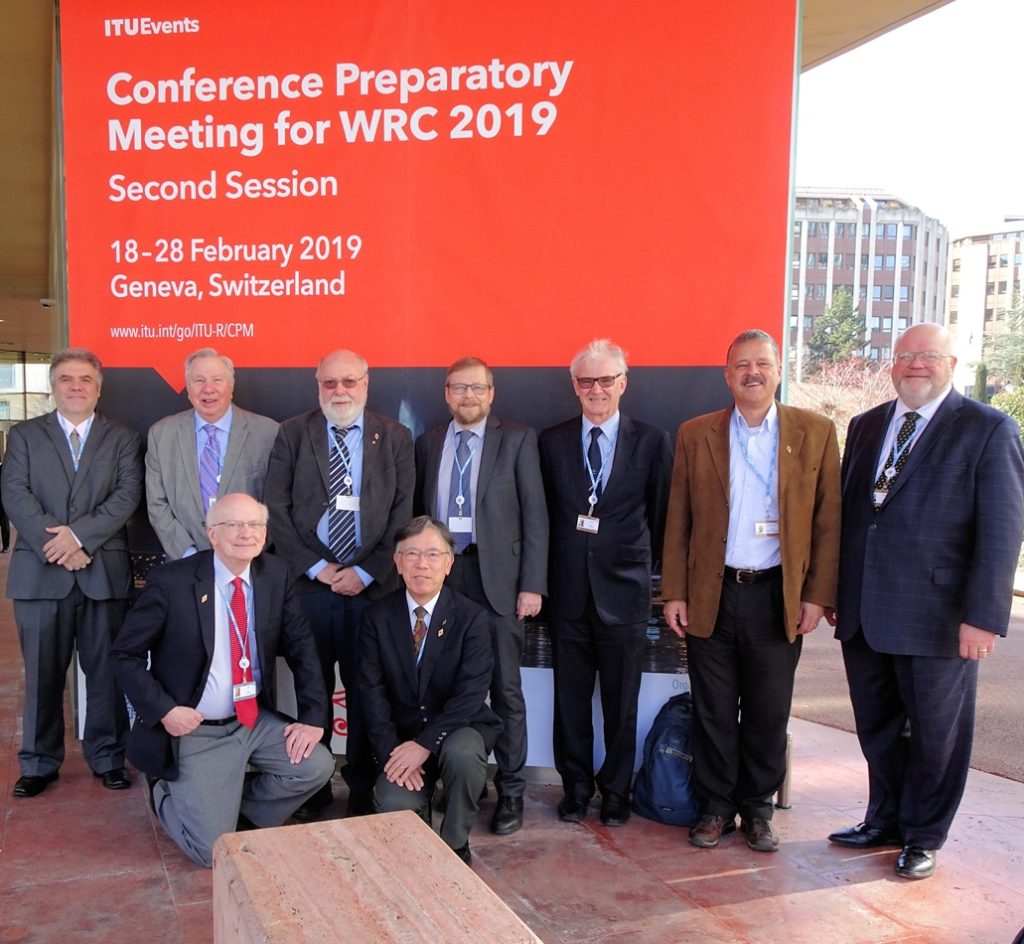
Radio Amateurs representing the Amateur Service in Geneva were (standing L‑R) Flavio Archangelo, PY2ZX; Bryan Rawlings, VE3QN; Dave Court EI3IO; IARU Vice President Ole Garpestad, LA2RR; Dale Hugues, VK1DSH; Hans Blondeel Timmerman, PB2T; ARRL’s Jon Siverling, WB3ERA, and (kneeling L‑R) Dave Sumner, K1ZZ, and Ken Yamamoto, JA1CJP [Courtesy of Dave Sumner, K1ZZ, photo originally posted on ARRL’s web site — https://​www​.arrl​.org/​n​e​w​s​/​i​a​r​u​-​r​e​p​r​e​s​e​n​t​s​-​a​m​a​t​e​u​r​-​r​a​d​i​o​-​a​t​-​w​r​c​-​1​9​-​p​r​e​p​a​r​a​t​o​r​y​-​m​e​e​t​ing ]

Print This Post

HamConBe

The HamConBE 2025 Conference is the Belgium’s premier forum for engineers, scientists, radio amateurs, researchers, and students to exchange ideas on advancements in radio technology and beyond. Admission to the Conference is free, but registration is mandatory.

Where: KU Leuven, Campus Arenberg III “Quadrivium” Celestijnenlaan 200, 3001 Leuven
When: Saturday 26th of April 2025

All details here: https://​hamcon​.be/

Program:

Amateur Radio (non-technical)

  • 20 years of Digital voice (NL) (Patrick, ON4PN)
  • Radiosports: the competitive side of ham radio (Franki, ON5ZO)
  • Ham radio as a tool: promoting amateur radio in the science and hacker/maker communities (Kristoff, ON1ARF)

Radio-Technology (technical)

  • Mains pollution by electronics-generated harmonics, consequences and mitigation (Thierry, ON5TE)
  • The issues with SDR (Morgan, ON4MOD)
  • Tracking of the Asian hornets with BLE and SDR (Gilles Callebaut/Jan Van Moer, KU Leuven Campus Gent / Van Moer Consultancy)
  • Meshtastic (Thijs (@GUVWAF), Meshtastic Project)

Radiotechnology in science and space

  • Ham radio beacons aboard pocket-qube satellites for investigating sporadic E in the ionosphere (Jurgen Vanhamel, ON5ADL, TU Delft / KU Leuven)
  • Radioastronomy: An Introduction (Bernard, ON4CGX)
  • Introduction to Weather Radar: principles, challenges and applications (Maarten Reyniers, KMI)

Workshop

  • Building a TinyGS Station (Jeffrey Roe, EI7IRB)

Print This Post

M17 Conference 2025 in Poland, September 6 – 7 (Sat-Sun)

The M17 Foundation is pleased to inform that the M17 Conference 2025 will take place on 6 – 7 September, in Nowy Dwór Mazowiecki, Poland. The main topic will be open-source software and hardware development in the amateur radio realm, with the emphasis on M17 and all the solutions around it. Any topic that might be interesting to the ham radio community is welcomed!

The venue is located very conveniently, just 40km from Warsaw, and a stone’s throw from the Warsaw-Modlin airport. The event will be a combination of technical talk sessions and exhibitions. Admission is free.

Speakers and exhibitors are required to register. The registration form is available through the link below.

More info: https://​m17foundation​.org/​m​1​7​-​c​o​n​f​e​r​e​n​c​e​-​2​025

Print This Post

ENAMS 2.0 available for pre-orders

What is ENAMS ?

ENAMS stands for Electrical Noise Area Measurement System. It is a network of receivers that automatically measures and records the background noise level in the radio frequency spectrum from 66 kHz to 31 MHz. This data is used to track the increasing levels of radio frequency interference and its impact on radio communication, particularly shortwave broadcasting and amateur radio.

Why was ENAMS created?

ENAMS was initiated by the German Amateur Radio Club (DARC) in response to the growing concern over rising noise levels in the shortwave bands. The lack of reliable and up-to-date interference measurements highlighted the need for a system like ENAMS to document and analyze the problem.

How does ENAMS work?

ENAMS utilizes Red Pitaya SDR receivers equipped with preamplifiers to cover the entire frequency range from 66 kHz to 31 MHz. These receivers are strategically located and measure the RF spectrum every ten minutes, recording both RMS and peak noise levels. The data is then collected and processed to generate statistical information and visualizations of the noise levels across different locations.

What are the key features of ENAMS 2.0?

ENAMS 2.0 is an improved version of the original system with several enhanced features:

  • Local Data Storage: ENAMS 2.0 receivers can store up to 5 years of raw and calibrated data locally on a 256 GB disk. This allows for offline operation and easier relocation of the stations.
  • I/Q Data Retrieval: ENAMS 2.0 stores I/Q data from recent measurements, allowing for retrieval and further analysis.
  • Increased Computing Power: An additional Raspberry Pi provides more processing power for handling the increased data storage and processing requirements.
  • Enhanced Reliability: The system has been designed for continuous 24⁄7 operation with improved reliability.
  • Offline Operation: ENAMS 2.0 units can operate without a continuous internet connection. They only need to connect periodically to upload data.

Why is ENAMS 2.0 important for the amateur radio community?

ENAMS 2.0 provides crucial data that can be used to advocate for better protection of amateur radio frequencies. The statistically sound information gathered by the system demonstrates the inadequacy of previous ITU noise measurements in today’s environment, where cumulative noise from various sources is significantly impacting radio communication.

How can I contribute to the ENAMS project?

The IARU R1, in collaboration with DARC and the ENAMS team, is planning to make a second batch of ENAMS 2.0 units available by late 2024. Amateur radio operators and organizations can contribute by:

  • Purchasing an ENAMS 2.0 Unit: If you are interested in supporting the project and hosting an ENAMS 2.0 receiver, you can pre-order a unit from the DARC here https://​darcverlag​.de/​E​N​A​M​S​-20
  • Spreading Awareness: Raising awareness about the ENAMS project within your local amateur radio community and encouraging participation.

Where can I find more information about ENAMS?

More information, including technical details, data visualizations, and the latest updates on the ENAMS project, can be found on the ENAMS website: www​.enams​.de.

Preorder your unit here : https://​darcverlag​.de/​E​N​A​M​S​-20

Print This Post