


Material published on this page may be subject to copyright.
How to start an Intruder Watch
As the amount of all kind of intruders in the HAM Radio bands is rapidly crowing, the role of the IARU Intruder Watch Service (IARU IWS) is becoming more and more important. A number of national Monitoring Coordinators and Volunteers is watching our bands since many years, but more needs to be done to raise awareness of societies and countries where there exists actually no national monitoring team.
Your help, as Radio-Amateur operator or SWL is key to contribute in keeping our most important asset – the HAM Radio spectrum – free of intruders.
How can you help? (read more…)
Monitoring with WebSDR
A WebSDR is a simple Software-Defined Radio receiver connected to the internet, allowing multiple users to listen and tune it simultaneously. SDR technology makes possible that all users can tune independently, and so listen to different signals. WebSDR
Monitoring with KiwiSDR Network
KiwiSDR Network, a KiwiSDR receiver network available on the internet with Direction Finding feature TDoA: Time Differerence of Arrival.
- Kiwi Operating Information
- How to use TDoA feature on the KiwiSDR Network (scroll to “Usage”).

ITU and CEPT Regulations and Documents
- CEPT ECA Frequency Allocation Table
- ITU Classification of Emissions
- ITU Technical Identification of Digital Signals
- ITU List of Members States
- ITU Convention ARTICLE 48. Military services
Signal Identification
- IARU IWS Wiki Most usual non-amateur transmission modes found on the amateur radio bands. With Screenshots, audio recordings and video recordings of each mode
- ACF Real-Time Autocorrelator, by ANgazu, EA4021SWL: software tool designed to easily and practically determine the PRI (Pulse Repetition Interval) / PRF (Pulse Repetition Frequency) of OTH (Over the Horizon )radars, although it also allows measuring the ACF of other signals. With the PRI/PRF of a radar, and its banwidth, you can easily identify it by looking for these data at the RADAR section of the IARU IWS Wiki
- Letter Beacon
- Sigidwiki, Signal Identification Guide
- Radio Station Interval Signals, “Jingles”
- Wavecom Decoder Help (click on “Transmission Modes”)
- Media files
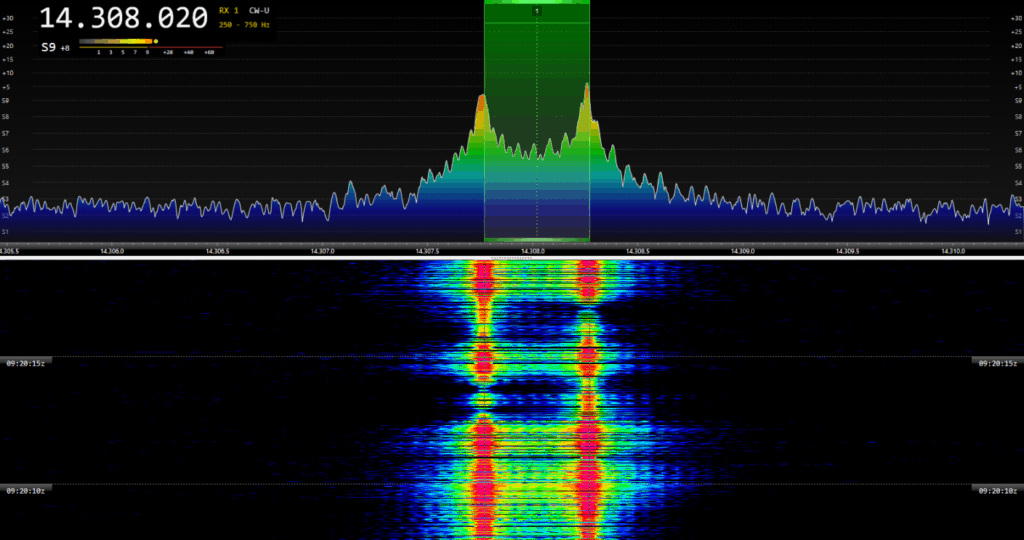
Radars


Fishing Buoys on 10 m
Devices installed in fishing buoys used to help the radiolocation of fishing gear – nets, longlines – send illegal transmissions in A1A (CW) and F1B (FSK) on the 10 m band, mostly from 28000 kHz to 28450 kHz. These transmissions are repeatedly sent every few minutes all day long.
Due to propagation conditions and sporadic E‑layers, they are usually best received during the summer months.
The largest amount of the fishing buoys transmit A1A (CW) signals consisting in a short preamble tone (few seconds long) followed by one to 3 letters. Characteristic feature is also the mostly slowly rising preamble tone before the identifier follows. However, buoys with a constant carrier are also observed.
Fishing buoys using F1B signals transmit their GPS position in an encrypted message. Shift is ca. 300 Hz.
List of Fishing buoys (August 2019)
IARUMS R1 Fishing buoys Report 2021


