


Frequency Shift Keying or FSK (Frequency Shift Keying) is a modulation technique for the digital transmission of information using two frequencies for each symbol. The modulating signal only varies between two discrete voltage valuesforming a train of pulses where one represents a “1” or “mark” and the other represents “0” or “space”
ITU emission type classification: F1B
F : Frequency modulation
1 : A single channel containing quantized or digital information without the use of a modulated subcarrier
B : Telegraphy for automatic reception
Several MIL and GOV modes are base on FSK and their variants (Like MFSK). Also, other modes based on FSK exist and are used by intruders in the amateur radio bands (e.g.: Fishing buoys)
FSK
Several CIS modes are transmitted with FSK (F1B) modulation. The only thing varying in them is the shift used (most usual are 200 Hz, 250 Hz and 500 Hz) and the Baud rate in the transmission (most usual Baud rates are 50 Bd and 75 Bd; left image). But there are also other transmissions using FSK, and other shifts (e.g., F1B 850 Hz 50 Bd on 14002 kHz CF; center image), or the ones sent by fishing buoys (Shift = 300 Hz; 50.1 Bd; right image) on the 10 m band


Audio
Video
F1A
F1A is the ITU classification of emissions code for:
F : Frequency modulation
1 : A single channel containing quantized or digital information without the use of a modulated subcarrier
A: Telegraphy – for aural reception
THe CIS-36 50 mode uses F1B ( Shift = 200 Hz; 50 Bd) and F1A. The F1A part can be heard by listenning, with a narrow filter, to the superior frequency of the two used in the transmission, and sounds like a CW (A1A) Morse transmission.
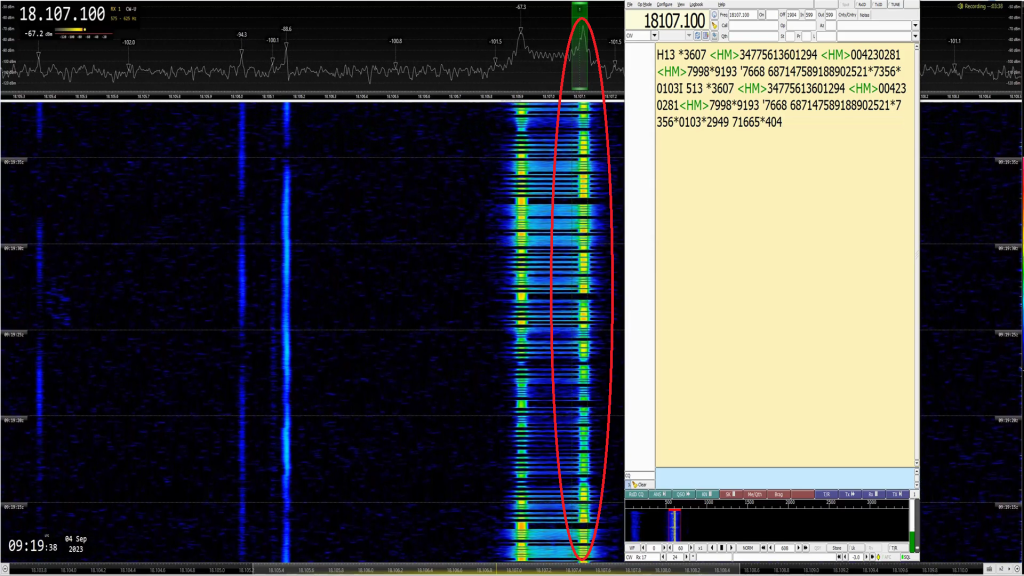
FSK — based
The DPRK FSK 600 ARQ is a FSK — based mode from the Democratic People’s Republic of Korea (DPRK; North Korea).
ITU Classification of emissions = F1D.
Shift = 600 Hz
Bauds rate = 600 Bauds.
RX: Mostly on 20 m, but also on the 17 and 15 m bands

MFSK
MFSK stands for Multiple frequency-shift keying, which is a variant of FSK that uses more than two frequencies.
A mode using MFSK is the MIL-148141A Standard, also known as ALE (Automatic Link Establishment).
Modulation: MFSK‑8
Bandwidth: 1.75 kHz
Baud rate: 8 x 125 Bd
RX: Most usually heard on the 40, 20, 17 and 15m bands.
