The IARU Intruder Watch Service (IARU IWS) Newsletter August 2025 is now available.
Click on the link to read it!
Print This Post
The IARU Intruder Watch Service (IARU IWS) Newsletter August 2025 is now available.
Click on the link to read it!
The IARU Intruder Watch Service (IARU IWS) Newsletter July 2025 is now available.
Click on the link to read it!
The information that follows was posted on the IARU Global web site on July 18th:
AST & Science LLC (operating as AST SpaceMobile) currently deploys commercial satellites in Low Earth Orbit that utilize spectrum allocations within the 430 – 440 MHz amateur and amateur satellite bands for Telemetry, Tracking, and Command (TT&C) operations. The satellites, designated Bluebird 1 – 5, were launched on September 12, 2024, and function under an FCC Space Bureau authorization pursuant to Article 4.4 of the ITU Radio Regulations. This provision permits administrations to authorize stations using frequencies that are not in accordance with the ITU‑R Table of Frequency Allocations or other relevant regulations, provided such use does not cause harmful interference to other administrations authorising services that are in accordance with the Table of Frequency Allocations.
Bluebird satellites employ the following frequencies for TT&C operations with 50 kHz bandwidth utilizing Gaussian Frequency Shift Keying (GFSK 2400): 430.500 MHz, 432.300 MHz, 434.100 MHz, 435.900 MHz, and 439.500 MHz. Additionally, AST’s prototype satellite Bluewalker‑3 transmits telemetry on 437.500 MHz. These frequencies are not intended to carry the service user traffic, and the use of these UHF frequencies is proposed for exceptional circumstances when the normal Q and V Band TT&C channels are not useable (40 and 60 GHz bands).
In June 2025, the FCC Space Bureau accepted a further application from AST & Science LLC for the deployment of 243 additional satellites intended to use the 430 – 440 MHz spectrum for telemetry purposes.
Supporting material for the new application also suggests that use of the 430 – 440 MHz range by the new additional satellites may be limited as these are expected to use the S‑band (around 2 GHz) exclusively for TT&C when needed.
The 430 – 440 MHz band supports a range of amateur and amateur satellite applications, including weak-signal communications, space communications, digital television, data transmission, repeaters, and other uses. There is no specific sharing study considering the impact of the TT&C transmissions in the 430 – 440 MHz band on these amateur applications despite the Primary status of the amateur service allocation in Region 1 and 11 countries in Region 2.
The International Amateur Radio Union (IARU) and its member societies have expressed concerns regarding the lack of any technical assessment on the potential interference arising from AST satellite TT&C transmissions affecting the aforementioned applications. The IARU maintains that invoking Article 4.4 of the Radio Regulations is inappropriate in this context, given the considerable risk of interference associated with AST’s use of the amateur allocation.
To address these issues, the IARU has communicated its position in correspondence to the Director of the ITU Radiocommunications Bureau. IARU member societies are encouraged to engage their respective regulatory authorities about the implications of AST satellite TT&C transmissions within the 430 – 440 MHz band and to inform their members accordingly.
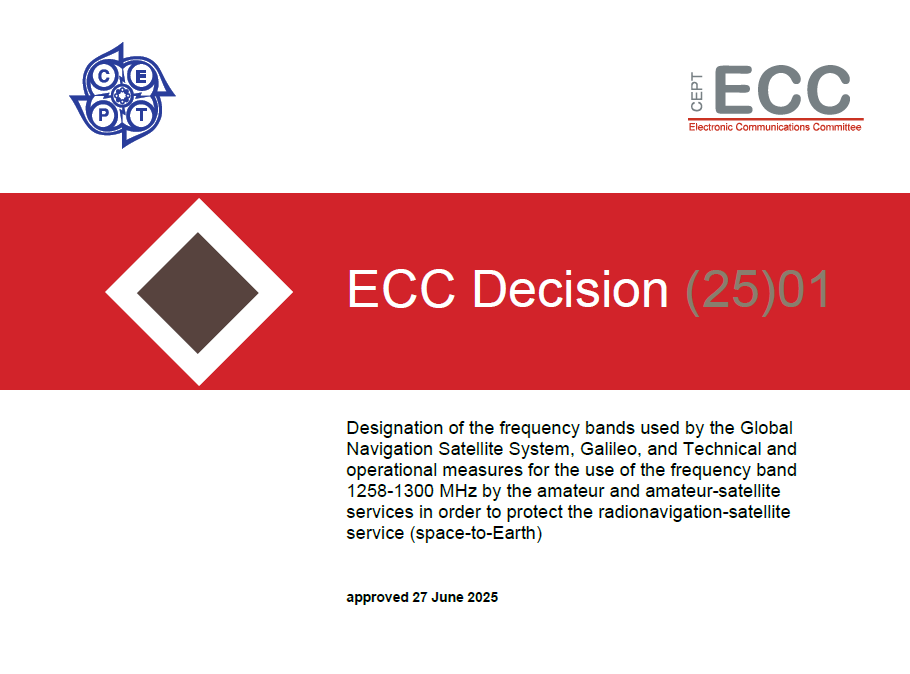
The CEPT ECC plenary meeting in June 2025 finalised and approved ECC Decision(25)01 that includes the technical and operational measures for the use of the frequency band 1258 – 1300 MHz by the amateur and amateur-satellite services in order to protect the radionavigation-satellite service (Galileo).
The Decision is now in force and the ECC plenary agreed that a preferred date for implementation shall be 27 December 2025. This is reflected in Decides 4 of the Decision.
Activity now passes to the individual CEPT administrations to decide how this Decision will be implemented in their country. The status of the national implementation can be found here in the CEPT ECC document database.
Additionally an IARU support paper is available here that provides background on the elements in Annex 1 of the Decision relating to the 23cm band.
The IARU Intruder Watch Service (IARU IWS) Newsletter June 2025 is now available.
Click on the link to read it!
You are currently viewing a placeholder content from Facebook. To access the actual content, click the button below. Please note that doing so will share data with third-party providers.
More InformationYou are currently viewing a placeholder content from Instagram. To access the actual content, click the button below. Please note that doing so will share data with third-party providers.
More InformationYou are currently viewing a placeholder content from reCAPTCHA. To access the actual content, click the button below. Please note that doing so will share data with third-party providers.
More InformationYou are currently viewing a placeholder content from X. To access the actual content, click the button below. Please note that doing so will share data with third-party providers.
More Information