Menu
Tunisia issues personal licences to operate

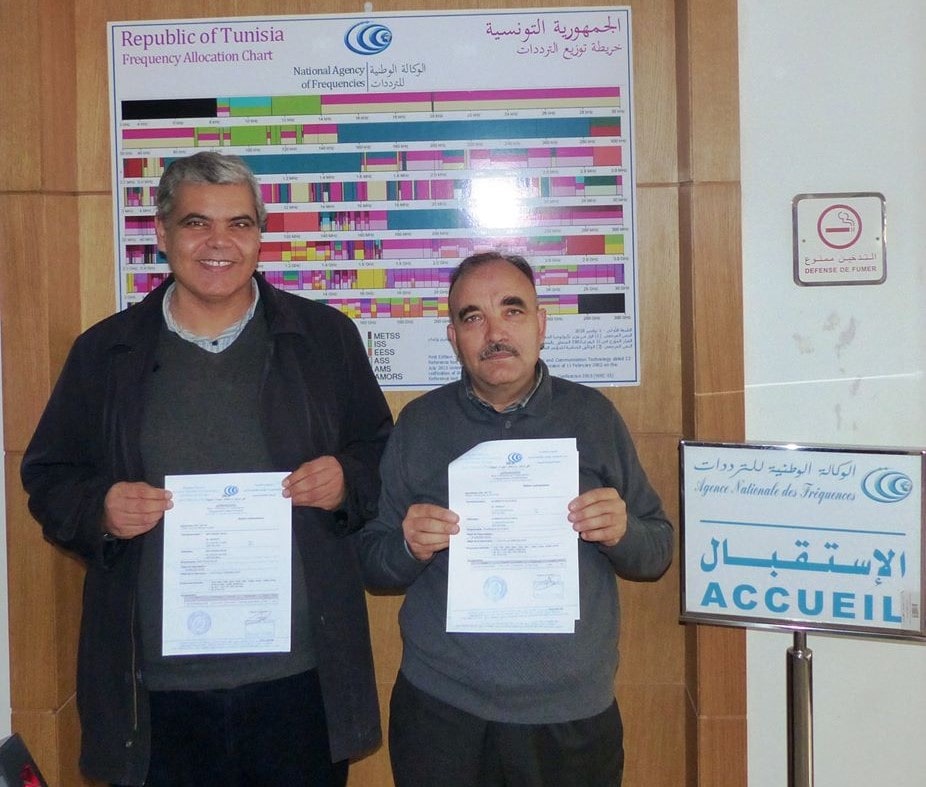
The first Authorizations to Operate have been issued to three Tunisian amateurs. These are the first issued since 1956. 3V8HB, 3V8MN and 3V1MB will soon be on the air from their homes rather than being restricted to operating from a club station. 

Issuing individual authorisations to operate is a new process in Tunisia and involves a number of stages, including equipment conformity checks. 

This is great news for Tunisians that the process now exists so that radio amateurs can practice their hobby from homes in full compliance with the Tunisian Laws. The IARU Member Society ARAT extends its thanks to the National Agency of Frequencies, the Ministry of Telecommunications and all involved parties for making this happen.

Print This Post

DK2OM receives IARU Diamond Award

After many years’ involvement in monitoring intruders on the amateur bands, Wolf Hadel, DK2OM, has decided to retire at the end of 2019. Wolf has worked for the DARC monitoring system in Germany for more than 30 years and since 2005 has also coordinated the IARU Monitoring System of Region 1 (IARUMS).

Wolf has made a name for himself over the years as a committed radio amateur and competent band guard, and he is known for his excellent contacts with the official spectrum monitoring units. At Ham Radio 2016, it was my pleasure to award him the IARU Region 1 medal for his fight against illegal intruders on our bands and to recognize his ongoing exceptional leadership of the successful IARU monitoring system.

Wolf has worked closely with monitoring activities in the other IARU Regions and has built an excellent reputation amongst his colleagues around the world.

Wolf has also worked as a competent specialist author in recent years, together with Peter, HB9CET, and has mainly reported on digital intruders and Over-the-Horizon radars (OTHR) and has published monthly the much-respected IARU MS Newsletter. 

In recognition of his contribution to spectrum monitoring over the years, not just in Region 1 but across the whole of IARU, on his retirement Wolf has been awarded the IARU President’s Diamond Award for his outstanding contribution to amateur radio spectrum defence through leadership of the IARU Monitoring Service. This is a well-deserved recognition of a very significant contribution to the amateur radio service. I congratulate Wolf on this award and sincerely thank him for his work over the years. We all wish Wolf a happy retirement. 

Until the General Conference of IARU Region 1 in October 2020 in Novi Sad, IARUMS Region 1 Vice-Coordinator Peter Jost, HB9CET, will perform these tasks as Coordinator ad Interim, supported by Gaspar Miró, EA6AMM, URE coordinator of the Spanish Intruder Watch. I thank Peter and Gaspar for their willingness to maintain the IARU Monitoring System of Region 1 until the Conference next year.

Don Beattie, G3BJ, President IARU Region 1

Print This Post

IARU speaks at ATU Workshop

IARU was present at the recent ATU African Telecommunications Union / ICT Day 2019 Commemorative Workshop — “Using Technology to Save Lives: Emergency Communications for Disaster Risk Reductions and Management”. The Workshop was held in Maputo, Mozambique and IARU was represented by Brian Jacobs, ZS6YZ and Leon Lessing, ZS6LMG. Brian presented an overview of the amateur capability for emergency communication and some of the pre-conditions for it to be effectively deployed. He also gave a second presentation on the IARU STARS program, which seeks to support and encourage the growth of amateur radio in countries where it is not well established. 

Both presentations were well received, and gave rise to extended discussions about the public service role of amater radio and its role in developing the national skill infrastructure. 

Print This Post

STARS Working Group

The Chair of the STARS Working Group, Riri Azrak, OD5RI has indicated that he is finding it increasingly difficult to balance his business responsibilities in Lebanon with running the Working Group.

I have therefore agreed with him that he will become the Deputy Chair of the STARS WG and that a new Chair will be appointed until the next General Conference.

I am pleased to say that Hans Welens, ON6WQ, has agreed to return to lead STARS for that period. Hans ran STARS for 21 years until 2011, and I am very grateful to him for offering to step in for the next eleven months.

Please join me in thanking Riri for his work in STARS and wishing Hans every success in his role.

Don Beattie, G3BJ

President IARU Region 1 

Print This Post

Early Progress, Contention on Difficult Issues Mark First Week of WRC

Sharm El-Sheikh, Egypt, 1 November 2019

Week 1 of the 2019 World Radiocommunication Conference saw agreement reached on several issues on which discussions prior to the conference had revealed consensus. Those were the easy ones; the rest will be more difficult.

The early decisions here in Sharm El-Sheikh were only possible because of countless hours of work conducted within the ITU Radiocommunication Sector and the six regional telecommunications organizations (RTOs) since the previous WRC in 2015. Three of these decisions were on issues of interest to the IARU.

The band 47.0−47.2 GHz was allocated solely to the amateur and amateur-satellite services by the 1979 World Administrative Radio Conference. Commercial wireless broadband interests had expressed some interest in the band being designated for International Mobile Telecommunications (IMT) and there was some concern that such a proposal might be made at WRC-19. The fact that none was forthcoming was due in part to the work of the IARU at the Conference Preparatory Meeting earlier this year and in the RTOs. The WRC has agreed to “no change” (NOC) at 47.0−47.2 GHz.
Another NOC decision that avoided impact on the amateur service applies to the band 5850 – 5925 MHz, which is an amateur secondary allocation in Region 2. Consideration of proposals involving other parts of spectrum in the 5‑GHz range will take much longer.

Finally, the WRC has agreed to make no frequency allocations or other changes to the Radio Regulations to accommodate Wireless Power Transmission for electric vehicles (WPT-EV). Much more work remains to be done on an urgent basis in the ITU and other standards organizations if radiocommunication services are to be adequately protected from harmful interference that may be generated by WPT-EV, both at the fundamental frequency and from unwanted emissions.

Consideration of a 50 MHz allocation in Region 1 to harmonize the allocations in the three Regions was the subject of spirited debate in a Sub Working Group chaired by Dale Hughes, VK1DSH, of the Australian delegation. The four RTOs in Region 1 made disparate proposals to the conference and a small group of administrations proposed NOC. For three days there was no progress toward a consensus solution but that changed on Friday morning. An agreement has been reached, subject to confirmation by the regional groups, that will provide administrations in Region 1 with flexibility in how to accommodate their amateurs.

One of the most difficult issues facing WRC-19 is to develop an agenda for WRC-23. There are dozens of proposals for agenda items and they cannot all be accommodated within available ITU resources. The substantive work of considering these proposals began on Friday afternoon and must be completed over the next two weeks.

Some meetings on the more difficult issues are scheduled for Saturday, 2 November. Delegates have been warned to expect more intensive use of weekend and evening hours as the conference proceeds toward its conclusion on 22 November.

Print This Post