Menu
ITU‑R WP5A meeting #30 could not achieve consensus on the measures needed to protect the RNSS in the 23cm band. (Relating to WRC-23 AI 9.1b)

Working Party 5A meeting #30 met over the period 13th to 22nd September 2023 and despite extra meeting time allocated specifically to the development of the ITU‑R Recommendation M.[AS_GUIDANCE] the meeting did not reach a consensus on the technical and operational measures required to ensure the protection of the RNSS (radio navigation satellite service) in the amateur 23cm band. The measures aim to identify parts of the frequency band with associated amateur transmitter power limits that can help protect the RNSS operations. By the close of the meeting three alternative solutions remained unresolved in the draft document.

This outcome was reported to the WP5A plenary meeting and the subsequent parent Study Group 5 meeting but despite further efforts still no outcome could be achieved. Since the recommendation will be important for WRC-23 discussions it is expected that further efforts will continue to try to find a solution.

On a positive note the Draft New Report ITU‑R M. [AS_CHARACTERISTICS] was finalised by WP5A an approved in Study Group 5.

The IARU report from the WP5A meeting can be downloaded here.

Print This Post

IARUMS R1 successful action: SuperDARN radar transmissions on 20 m.

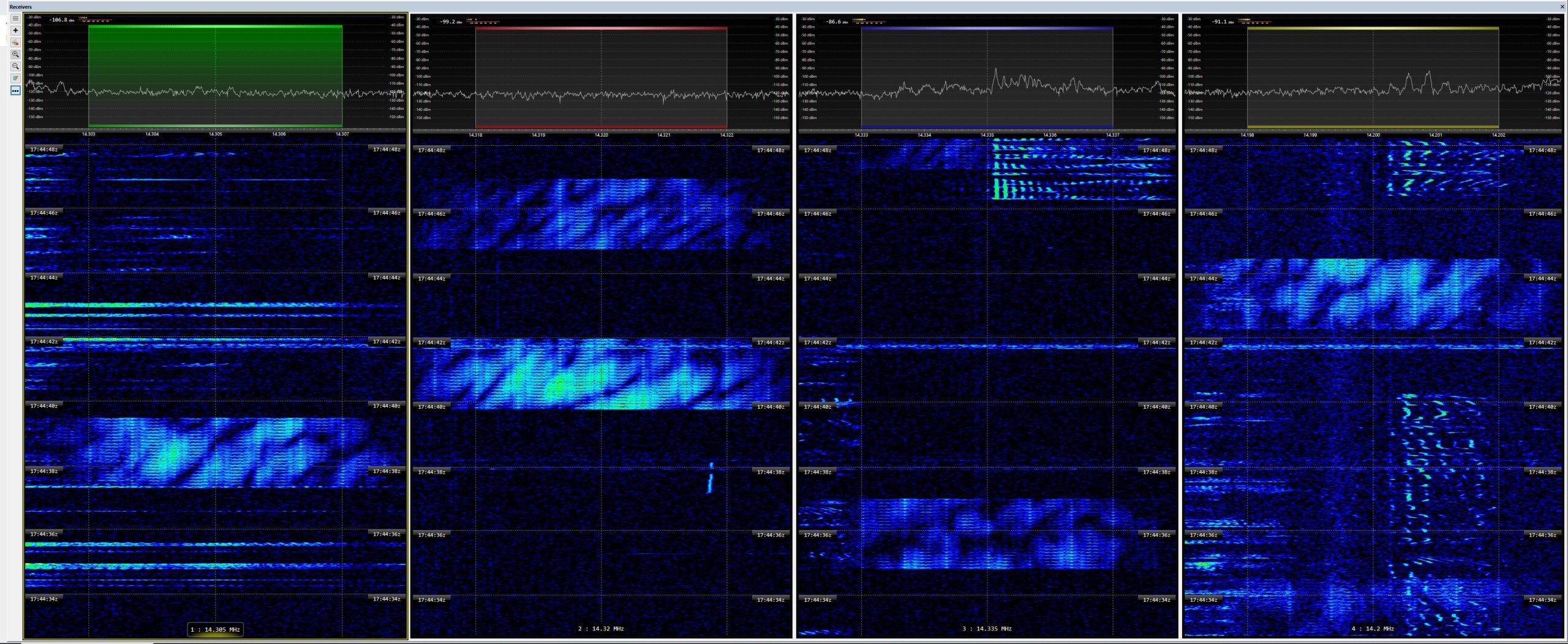
On April 13, 2023, Pekka, OH2BLU, the SRAL (Finland) IARU Monitoring System coordinator, reported at 1119 UTC the reception of transmissions sent by a SuperDARN radar (SuperDARN: Super Dual Auroral Radar Network) on the 20 meters band, specifically on 14200 kHz CF: short bursts using an approximate bandwidth of about 4.5 kHz. In the following days, several IARUMS Region 1 volunteers also reported such transmissions.

These transmissions could also be observed during May 2023 on other frequencies in the 20 meters band too, due to the frequency hopping method that this radar often uses.

SuperDARN radar bursts on 20 m, May 2023

Several members of the IARUMS R1 team worked actively in the identification of these transmissions, providing screenshots, audio recordings, IQ recordings and triangulations performed by TDoA through the KiwiSDR network.

The IARUMS R1 coordinator, Gaspar, EA6AMM, contacted a SuperDARN network’s representative, who is also a North American licensed radio amateur operator, to inform him of the reception of the transmissions in the 20 meters band and to provide him with all the data collected about these transmissions.

SuperDARN radar bursts on 20 m., May 2023

The SuperDARN Network representative actively cooperated with the IARU Monitoring System Region 1 in order to identify the signals, performing extensive research on all transmissions sent by all SuperDARN Network radars around the world.

On June 2023, after his research, he confirmed that the transmissions were indeed coming from a recently activated radar of the Network that was in the testing phase. He also conveyed the apologies of the entire SuperDARN community for those transmissions and communicated to his colleagues the ITU RR on the frequencies of the 20 m amateur radio band, which we provided to him, so that these transmissions would not be sent again in this frequency range in the future.

The IARU monitoring System Region 1 wishes to thank this SuperDARN Network representative for his cooperation and help, and appreciates the resolution of this case.

A SuperDARN radar site. (Source: Wikipedia. Author: Drm310. CC BY-SA 3.0)
Print This Post