Menu
100 years of Czech Radio, competition & diploma

Special station activation 

The special station, which will earn you 5 points in the competition for the 100th anniversary of the start of regular radio broadcasting in Czechoslovakia and the connection to it is a condition for obtaining the gold diploma, will be activated on the weekend of 3 and 4 June 2023 and will be identified by the call sign OL100R. To commemorate the pioneers who started radio broadcasting, this station will broadcast on medium waves on the frequency 1233 kHz with the A2 and A3 modulation and the connections to this station will be established crossband. 

Station OL100R will announce the frequencies in the amateur bands on which it will listen to your call and will answer to you on 1233 kHz. Frequencies will be announced on 1233 kHz and at www​.ceskyradioklub​.cz. Operation will begin Saturday evening at 8 pm and will continue as long as there is interest in joining. If there is interest, the station may be activated later. Please use CW mode for telegraphic contact, OL100R will correspond to you with A2 modulation, for phonic contact use SSB mode, OL100R will correspond to you with A3 modulation. Listen to us on medium wave on 243.3 meters, 1233 kHz.

Link to article “100 years of Czech radio” LINK

Competition conditions

On the occasion of the centenary of the beginning of Czechoslovak radio broadcasting on May 18, 1923, the Czech Radio Club is organizing a radio amateur competition:

1. CRC requests the issuance of special call signs OL100RADIO, OL23RADIO, OL23RJ ‚OL100RJ, special call OL100R

2. These stations will be active between May 18 and June 18, 2023 on the KV and VHF bands.

3. Those interested will have the opportunity to obtain electronic diplomas

bronze for 3,

silver for 15,

gold for 25 points

5 points for a contact to the special station . The frequencies and time of operation of this station will be published later, follow the communication channels of CRC.

2 points for 1 a contact with stations OL100RADIO, OL23RADIO, OL23RJ and OL100RJ on different bands and different types of traffic — CW, SSB.

1 point for 1 a contat with OL100RADIO, OL23RADIO, OL23RJ and OL100RJ stations on different bands and different types of traffic — FT4, FT8 and RTTY-

The contacts repeated on the same band by the same type of traffic is not counted.

In order to receive a gold diploma, connection with the special station is mandatory.

4. Diploma manager — OK1MP, The same conditions for obtaining a diploma apply to listeners, they only demonstrate listening. Requests are sent to ok2za@​atlas.​cz.

5. QSL cards — sent (QSL service CRC, or direct) QSL cards will be answered with a card after verification of the connection, QSL manager: OK1MP. We recommend using the OQRS system on Club Log to request QSL cards. You will not overload the QSL service!

6. All contacts with OL100RADIO, OL23RADIO, OL23RJ and OL100RJ will be put on LOTW.

7. You find all informations about all results of an activity on special web www.cro100.cz.

Print This Post

ITU‑R Working Party 5A meeting #29 and the 23cm band and RNSS (radio navigation satellite service) coexistence measures relating to WRC-23 AI 9.1b

Over the period 9th to 19th May 2023, the preparatory work for WRC-23 agenda item 9.1bcontinued in ITU‑R Working Party 5A (WP5A). Two deliverables are under discussion:

1) Draft ITU‑R Report M.[AMATEUR_CHARACTERISTICS] – this reports on the specific 23cm band amateur and amateur satellite service technical parameters and operational characteristics used in the studies now published in ITU‑R Report M.2513 – 0.

2) Draft ITU‑R Recommendation M.[AS_GUIDANCE] – this will recommend guidance that national administrations can take to facilitate the protection of the radio navigation satellite service from harmful interference from amateur radio stations.

Ahead of this WP5A meeting the IARU global WRC-23 9.1b team led by G4SJH developed and submitted two contributions, one for each deliverable above. As usual, the IARU participated in the meeting to present the contributions and take part in the ongoing discussion and negotiations. The IARU contribution to the Guidancerecommendation proposed specific limits for EME operation in the range 1296 – 1300 MHz. The proposal was largely adopted but only in the range 1298 – 1300 MHz. The IARU contribution to the “characteristics” reportproposed an annex containing a Monte Carlo style study assessing the impact of a range of amateur transmissions on a population of RNSS receivers around the amateur station. Contributions were also provided by a number of national administrations and a summary report of the meeting can be downloaded here.

The development of the recommendation is proving challenging although many of the IARU proposals remain in the draft document for further discussion. Challenges are arising from other proposals that could be judged to go beyond the original mandate for the work. In addition some proposals for technical and operational measures seem impractical from both an administration and amateur station perspective.

The study proposed for the characteristics report was accepted for now but is to be liaised to WP4C for consideration and possible revision to Report ITU‑R M.2513.

Meanwhile in CEPT the work in project team SE40 continued during the same period (15 – 17thMay) with their development of an ECC Report on the same coexistence problem. IARU contributed the same Monte Carlo study to that group where it now sits in the draft deliverable.

In ITU_R the work on this topic will continue at the next ITU‑R WP5A meeting in September with some urgency to finalise both deliverables ahead of the WRC.

Print This Post

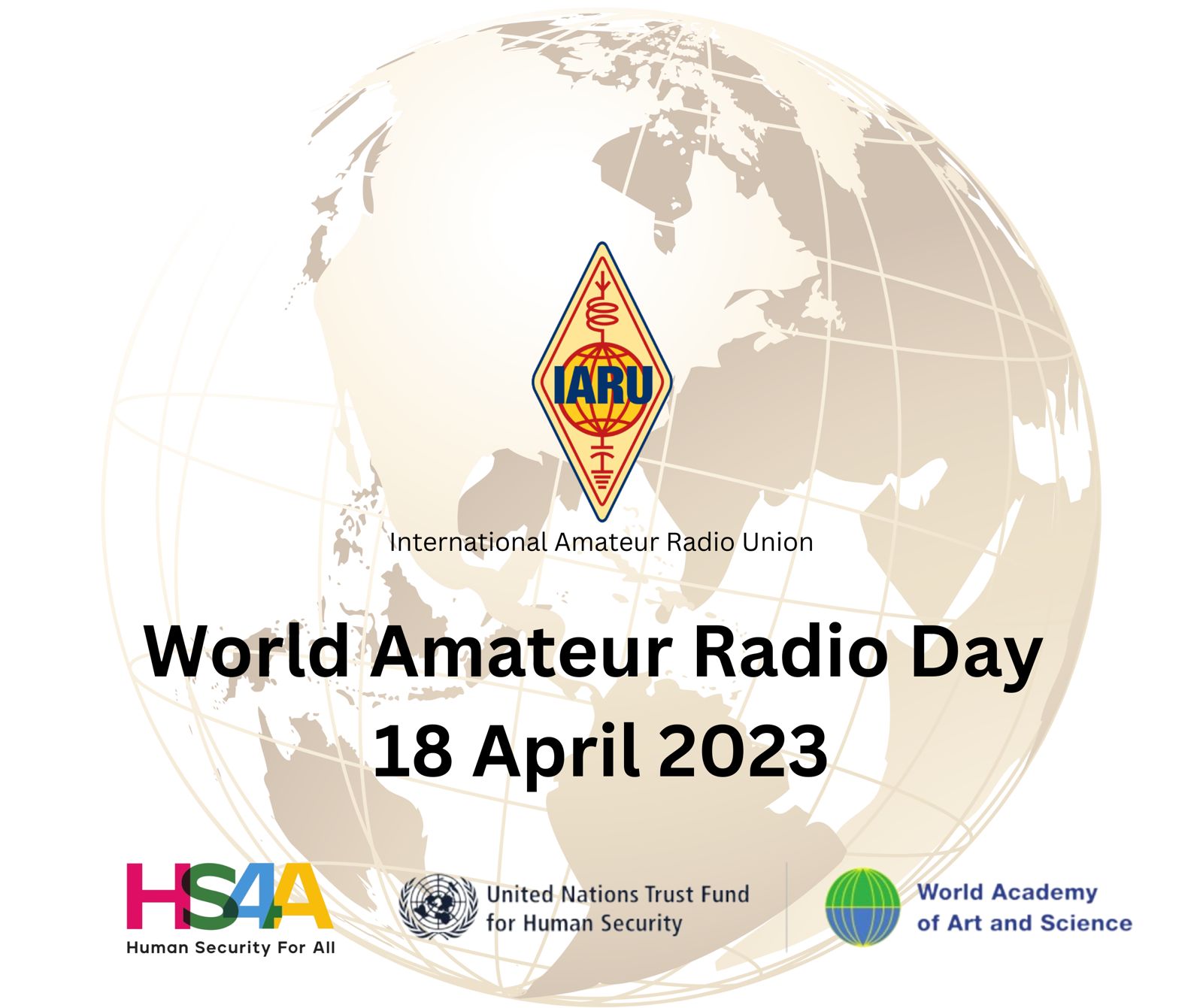
WARD — World Amateur Radio Day 2023 on 18 April

This is a reminder of World Amateur Radio Day on 18 April with the theme Human Security for All, HS4A.

Some activity has already started and there are event stations going to be active with special callsigns. An event website HS4A has been created https://​hs4a.iaru.org/

Don’t miss out to activate this day!

Information of WARD on the IARU global website: LINK

Earlier post on the IARU-R1 website: LINK

Print This Post