Menu
#SDR2020: the first French SDR Winter School

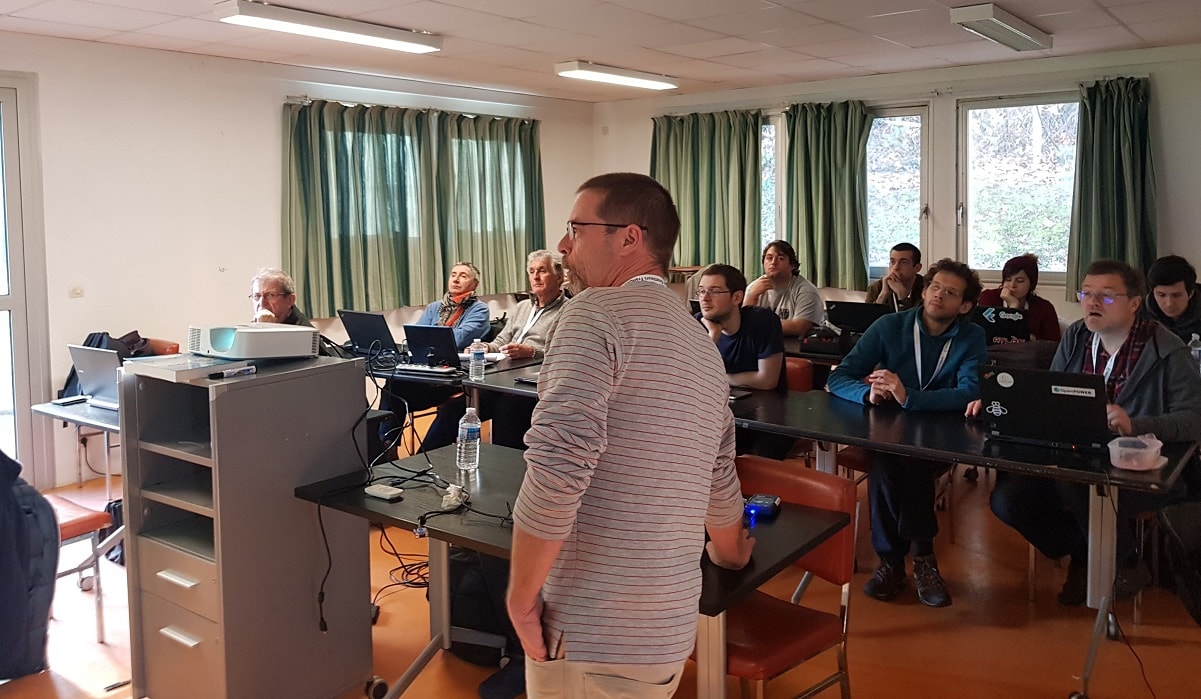
More than 30 “SDR Geeks” attended the first SDR Winter School, organized jointly by RCN-EG, the R.E.F. and group of trainers (Sylvain F4GKR, Eric F5HSV, Evariste F5OEO and Mehdi F4IHX) in the south suburbs of Paris from the 17th to the 21st of February.

The event was open to everybody and was attended by a very wide audience: whilst there was just a majority of licensed amateurs, there were 14 non-amateur attendees, some having no idea of what amateur radio is. Those attending ranged from 19 to 74 years old, coming from 4 countries (France, Belgium, Algeria and Senegal), many by train and plane. 

Participants at the SDR Winter School

The teaching program was structured in two parallel tracks:

  • The initiation track, dedicated to overview existing applications and tools (GnuRadio, LuaRadio, AdalmPluto, DATV etc.);
  • The expert track, focused on theory, DSP tips and tricks, covering topics like sampling, decimation and interpolation, demodulation, FFT processing, software architecture etc. For each topic a set of Jupyter Notebook Python examples were provided to implement the theory.

We also welcomed three guests for special sessions:

  • Satellite communication, presented by AMSAT‑F;
  • SDR Hardware, presented by Yannick F4HDA;
  • Radio astronomy by Jean-Jacques F1EHN.

While the entire program was free, it was possible at a limited cost to use the facilities available at the venue (restaurant and bedrooms). IARU R1 and REF also sponsored a few of the youngest visitors who could not afford the full cost.

Print This Post

Electromagnetic Compatibility — evaluation of the EU Rules

The European Commission has announced a Published Initiative on the Electromagnetic Compatibility — evaluation of the EU Rules. 

The first step in this process is a Roadmap which provides feedback to the Commission. This is then followed by a Public Consultation which allows for more detailed submissions

IARU has drawn up some broad comments and submitted them as feedback by the IARU Political Relations Committee.

The IARU comment document can be viewed here

IARU is acutely aware of the concerns of Member Societies and radio amateurs about the threat of increasing levels of noise and harmful interference and this is one response in a series of other initiatives by IARU.

Print This Post

Tunisia issues personal licences to operate

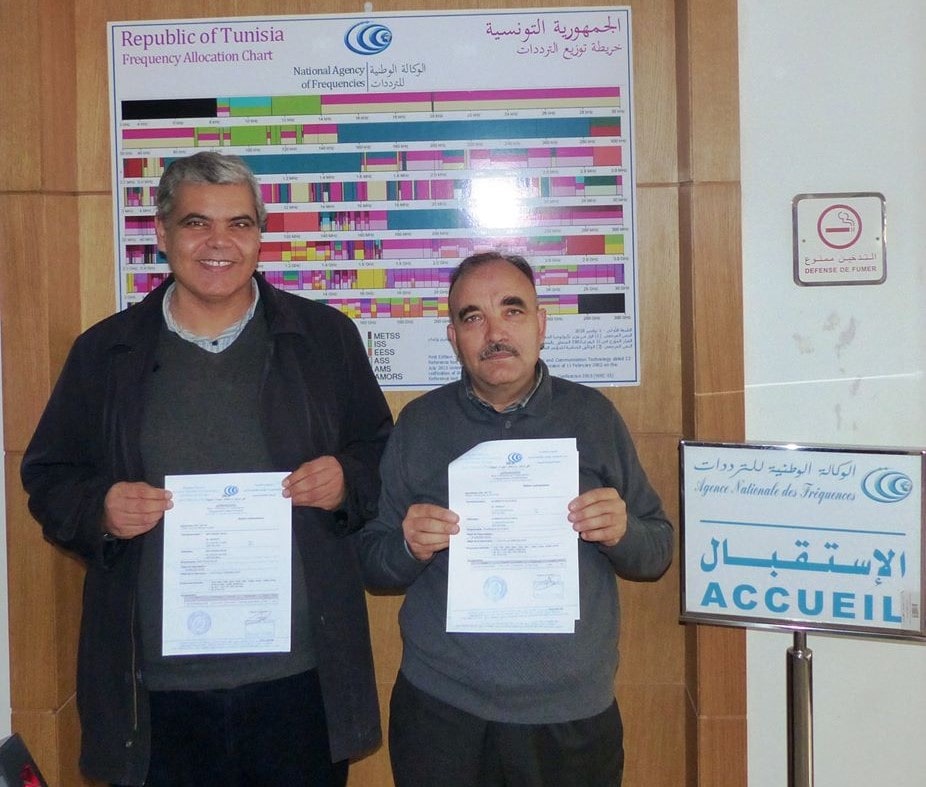
The first Authorizations to Operate have been issued to three Tunisian amateurs. These are the first issued since 1956. 3V8HB, 3V8MN and 3V1MB will soon be on the air from their homes rather than being restricted to operating from a club station. 

Issuing individual authorisations to operate is a new process in Tunisia and involves a number of stages, including equipment conformity checks. 

This is great news for Tunisians that the process now exists so that radio amateurs can practice their hobby from homes in full compliance with the Tunisian Laws. The IARU Member Society ARAT extends its thanks to the National Agency of Frequencies, the Ministry of Telecommunications and all involved parties for making this happen.

Print This Post

IARU speaks at ATU Workshop

IARU was present at the recent ATU African Telecommunications Union / ICT Day 2019 Commemorative Workshop — “Using Technology to Save Lives: Emergency Communications for Disaster Risk Reductions and Management”. The Workshop was held in Maputo, Mozambique and IARU was represented by Brian Jacobs, ZS6YZ and Leon Lessing, ZS6LMG. Brian presented an overview of the amateur capability for emergency communication and some of the pre-conditions for it to be effectively deployed. He also gave a second presentation on the IARU STARS program, which seeks to support and encourage the growth of amateur radio in countries where it is not well established. 

Both presentations were well received, and gave rise to extended discussions about the public service role of amater radio and its role in developing the national skill infrastructure. 

Print This Post