The IARUMS Region 1 Newsletter September 2019 is now available. Click here!
Print This Post
The IARUMS Region 1 Newsletter September 2019 is now available. Click here!
The entire month of December several youngsters under the age of 26 will become active with YOTA as suffix in the callsign. The idea for this is to show the amateur radio hobby to youth and to encourage youngsters to be active on the ham radio waves.
You won’t hear YOTA stations often during the year. Thus, the only chances are the camp stations during YOTA summer and subregional camps. And of course, an extended presence during the December YOTA Month activity. Over 40 stations signing YOTA suffixes will be qrv in about 2 months of time.
Give a demonstration in a school or local club, gather together with your friends, grab a pizza and make some QSOs or enjoy a great pile-up. Let us all show this great hobby to the world. Because we know that there is youth in hamradio!
Feel free to make a QSO with the youngsters, they are happy to get some attention and exchange information. Licensed and unlicensed youth will be making QSOs, be aware this could be their first radio contact ever and give them a chance to experience a possible new hobby.
There will be an award program available as well. Work as many YOTA stations on as many bands as possible and be eligible for your Bronze, Silver, Gold and Platinum award for free. This program promotes the radio activity on the air waves and shows that there is and will be activity in the future. Visit our website www.events.ham-yota.com for more information about the awards rules.
If you are under the age of 26 get in contact with your countries youth coordinators and get on the air with these special calls during upcoming December. It will be a pleasure to work a lot of new youngsters on the bands!
We hope to crack 100.000 QSOs this December for the first time ever, so help us to achieve this goal set by the future of amateur radio – the Youngsters On The Air!
Feel free to follow the activities on our homepage as well as on our social media channels @hamyota.
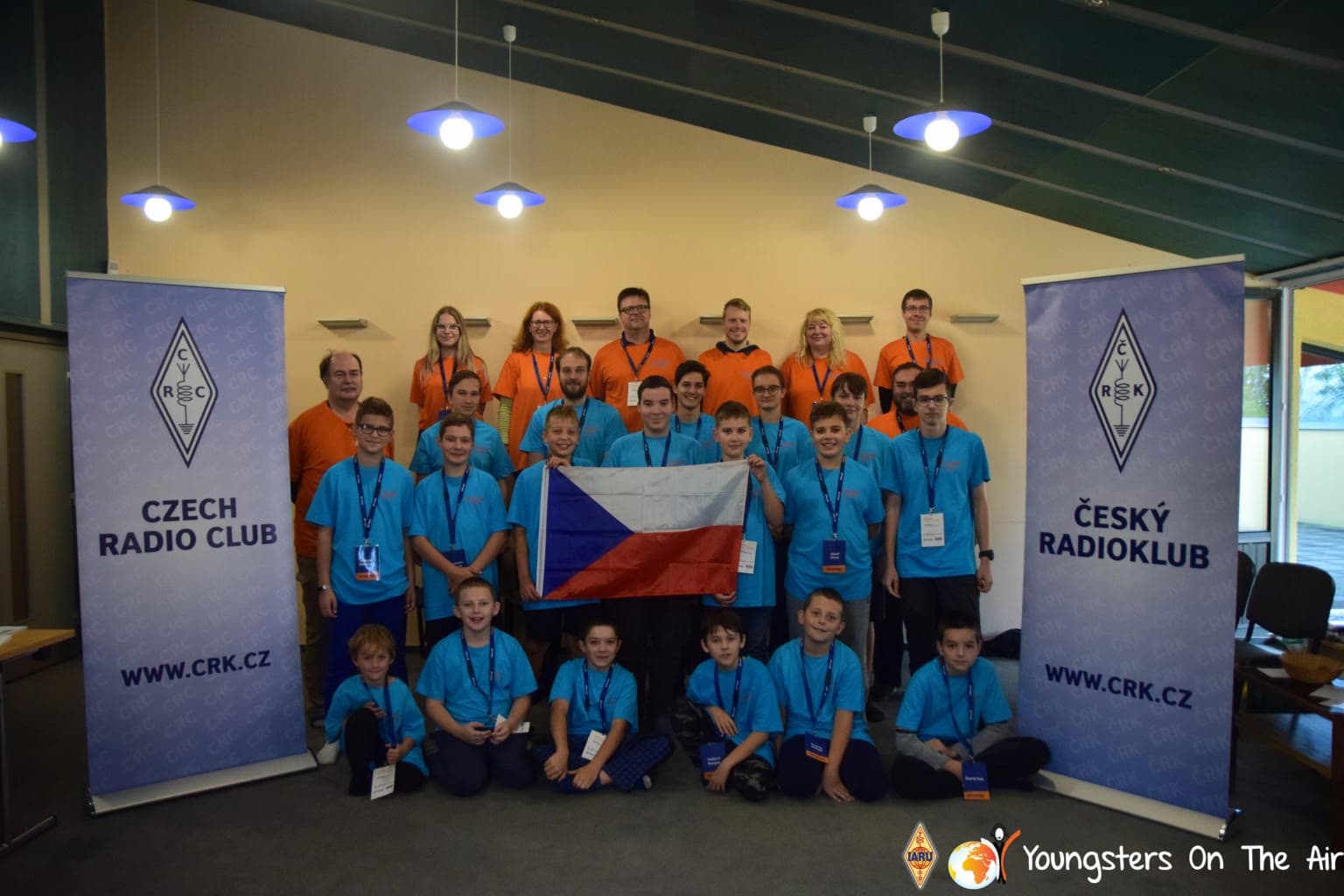
The Czech radioclub “CRC” organized from 27. 9. to 29. 9. 2019 a subregional YOTA camp called “Weekend of Experiencies” which took part in the south part of Czech Republic with participation of 18 youngsters and 9 lectors from the OK and OM member societies.
The first Czech YOTA Subregional camp started on Friday nearly before 4 p.m. with the arrival of the first participants. Registration of newcomers lasted until 7 p.m. when Martin OK1VHB began with his introduction into HAM radio and HAM spirit. Program continued with a lecture of Honza OK1JD about physics, antennas, radios and QSO basics. All of the participants learned how to make a phone contact and in the end of the day everybody was able to understand the principles, so the night 80 m operation could follow. After a little stress before first CQs the small expectations of all lectors were quickly exceeded. Children were really outstanding and their honest enthusiasm and opened mind were a big surprise.
It’s important to say that this camp was for most of the kids their first touch with our hobby!
Believe me or not, our Saturday program started at 6 a.m. — kids are unstoppable! A lot of them couldn’t stay in bed and started to occupy the radio in the early morning.
Official Saturday’s program started with workshops. Participants were divided into 4 groups which rotated between five stands –
1) Fox hunting theory by Martin OK1VHB,
2) J‑Pole workshop by Jindra OK1NOR,
3) Electronics basics (teached by game) by Vlada OK2ZKR,
4) Sattelite operation by Leo OK2UUJ, and
5) DX, DXCC and contest basics by Honza OK1JD
After lunch we went out and tried ARDF connected with the SOTA activation. Every kids got receivers and their task was to find the fox hidden approx. three kilometers far from the camp. Despite our assurance that there is no need to get out of the road, of course kids decided to follow the signal exactly and set off straight into the impassable forest! Finish was nearby the watchtower were the HF and VHF SOTA set-ups were in advance prepared. The lookout tower showed to be the perfect place were to test J‑poles made in the morning. Unfortunately, it started to rain very heavily on the way back, so every kids had all of the clothes wet and the “responsible woman-part” of the organizational team (our CRC secretary Líba OK1LYL especially) made a decision to cancel all of the outside activities scheduled for the rest of the Saturday.
In the evening there was a OFF-air contest. At first it was necessary to teach the participants how to make a contest QSO. After two hours of practicing Honza OK1JD finally enounced that he is satisfied with the contesters performance and the big OFF-air contest could start. And it was amazing! Considering the most of the kids never heard about ham radio until Friday, it was simply unbelievable how they were suddenly able to make 3 – 4 QSO per minute.
The day ended with presentation about YOTA and YOTA summer camps by Martina OK2YLQ.
Last day of our camp started with presentation about PMR followed by PMR contest. Kids made a huge progress and it was joy to watch them how they are actually contesting so good they could in minute take part in the real ham contest.
After lunch we had a presentation “How to make DX on VHF, UHF and microwave” by Petr OK2ULQ.
We finished our camp with the awarding the winners of OFF-air contest and PMR contest. During the whole weekend there was a competition in painting OL19CAMP QSL card. The most beautiful one will be used as an official QSL card and will be distributed via bureau.
YOTA subregional is over and we must say everything went better than we expected! All of the kids were unbelievably enthusiastic and we could read in their faces, that ham radio impressed them enormously. We would like to thank our sponsors – IARU R1, Schark Technik a GES Electronics.
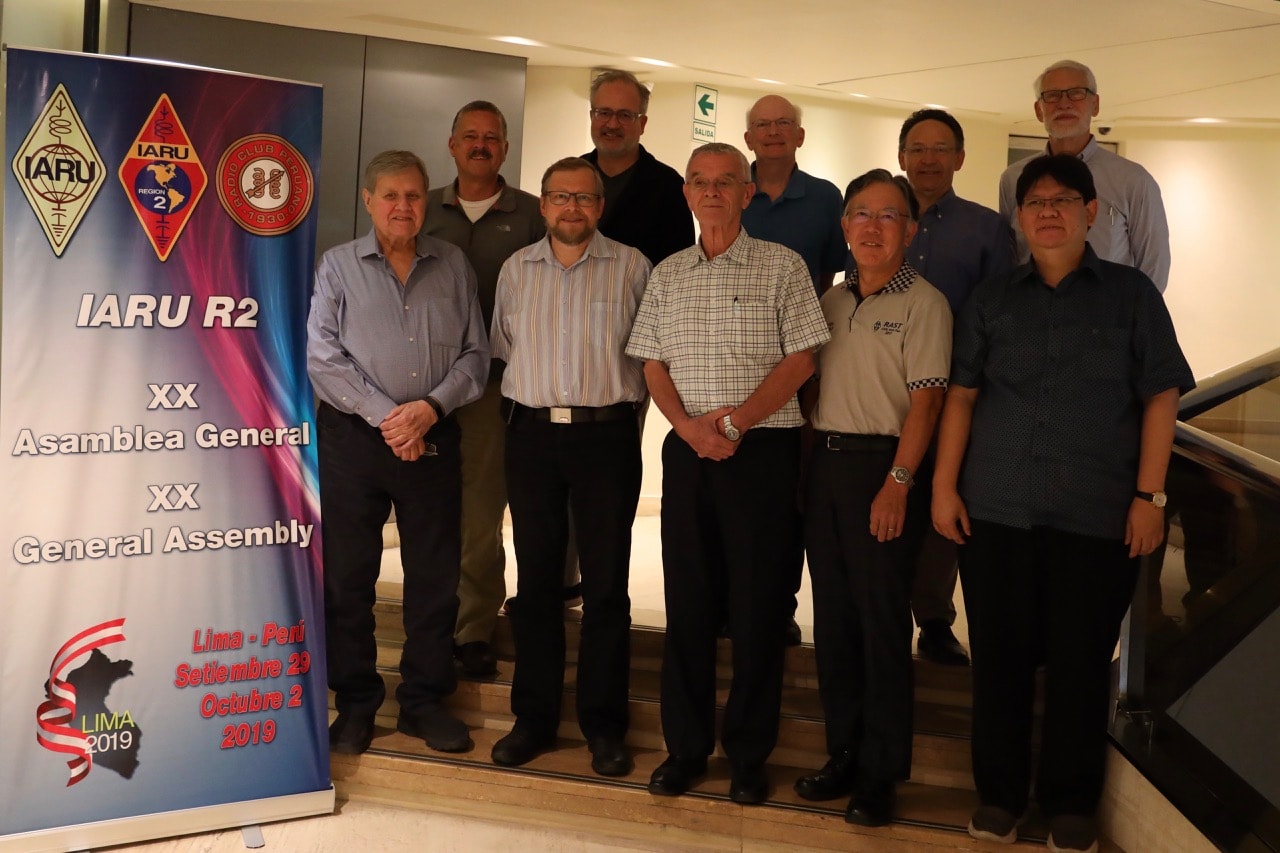
The Administrative Council (AC) of the International Amateur Radio Union (IARU) held its annual in-person meeting on 28 and 29 September 2019 in Lima, Peru, just before the triennial General Assembly of IARU Region 2. The AC is responsible for the policy and management of the IARU and consists of the three IARU international officers and two representatives from each of the three IARU regional organizations.
Attending the meeting were IARU President Tim Ellam, VE6SH/G4HUA; Vice President Ole Garpestad, LA2RR; Secretary David Sumner, K1ZZ; regional representatives Don Beattie, G3BJ, Hans Blondeel Timmerman, PB2T, Reinaldo Leandro, YV5AM, Ramón Santoyo, XE1KK, Wisnu Widjaja, YB0AZ, and Ken Yamamoto, JA1CJP. Region 2 executive committee member George Gorsline, VE3YV, was present as an observer.
The AC conducted its final review of IARU preparations for the 2019 World Radiocommunication Conference (WRC-19) of the International Telecommunication Union (ITU). WRC-19 will be held in Sharm El-Sheikh, Egypt, for four weeks beginning on 28 October. The conference has a lengthy agenda, with items of direct interest to the amateur service including consideration of improvements to the amateur allocation in Region 1 at 50 MHz, protection of existing allocations to the amateur service, and development of the agenda for the next WRC in 2023. For the past four years IARU volunteers and its member-societies have been working to influence the proposals from national telecommunications administrations and regional telecommunications organizations (RTOs) that will be considered in Sharm El-Sheikh. IARU efforts have reduced the number of potentially damaging proposals that otherwise might have been offered for consideration, but several challenges remain. A small team of IARU observers will attend WRC-19 and will work with amateurs and friends on national delegations to reach the best possible outcomes.
Looking beyond WRC-19 the AC recognized the need for an increased commitment to influencing the work of standards organizations, particularly the International Special Committee on Radio Interference (CISPR) and its participating national committees. The rising level of radio spectrum pollution caused by unnecessary and unwanted emissions from electronic devices such as wireless power transfer for the recharging of electric vehicles is a serious threat to radiocommunication services including the amateur service. While the work of the IARU is done by volunteers, attending meetings is expensive and requires the financial support of individual radio amateurs through membership of their national IARU member-societies. Additional qualified volunteers are needed in order to meet present and future challenges.
An extensive discussion was held to identify the principal challenges facing amateur radio and how the IARU and its member-societies can better address them.
Upgrading of the current websites of the IARU and its three regional organizations is underway and should be completed in the coming months. The AC adopted a Brand Guide to ensure a common identity across the IARU organization.
The theme for next year’s World Amateur Radio Day, 18 April, was confirmed as “Celebrating Amateur Radio’s Contribution to Society.”
The next in-person meeting of the AC is scheduled to be held immediately prior to the IARU Region 1 Conference in Novi Sad, Serbia, in October 2020. Virtual AC meetings are also planned beginning in December 2019 and January 2020.
As hurricane Lorenzo approaches the Azores the emergency network has been activated.
Amateur Radios will be active with the Government and emergency response teams.
Local analog and DMR repeaters, both in VHF and UHF, satellites and HF.
We ask all stations to give way for emergency traffic coming in and out of the Azores islands (CU, CQ8, CR8, CS8 and CT8 prefixes).
WORKING FREQUENCIES:
VHF – Priority Communication Systems (Repeaters) – Faial Island
1 – VHF Repeater (R0) (Cabeço Gordo): 145,600; Shift: ‑600KHz; Tone: 123hz (coverage Faial Island, Pico and S.Jorge)
2 – VHF (R7) repeater (Pico Verde): 145,775; Shift: ‑600KHz; Tone: 123hz (west side cover Faial island)
3 – UHF Repeater (Cabeço Gordo): 438,800; Shift: ‑7.6MHz; Tone: 123hz
4 – Alternative: direct frequency 145,500
UHF – DMR Digital Repeater
DMR Repeater – Faial Island (east side coverage of Faial Island and west of Pico Island)
RX Frequency: 438.300 TX Frequency: 430.700MHz
Slot2 – TG 26867 (Faial)
Slot1 – TG268 for outdoor communications
HF – Inter-Island Links
1 – 80 meters – 3,760.00 Mhz. – 3,770.00 Mhz. – 3,750.00 Mhz. (Inter-islands)
2 – 40 meters – 7,110.00 Mhz. – 7,100.00 Mhz. – 7,060.00 Mhz. (Inter-island)
3 – 20 meters – 14,300.00 Mhz. – 14,310.00 Mhz. – 14,320.00 Mhz. (Communications with the outside)
You are currently viewing a placeholder content from Facebook. To access the actual content, click the button below. Please note that doing so will share data with third-party providers.
More InformationYou are currently viewing a placeholder content from Instagram. To access the actual content, click the button below. Please note that doing so will share data with third-party providers.
More InformationYou are currently viewing a placeholder content from reCAPTCHA. To access the actual content, click the button below. Please note that doing so will share data with third-party providers.
More InformationYou are currently viewing a placeholder content from X. To access the actual content, click the button below. Please note that doing so will share data with third-party providers.
More Information