Menu
COVID19 special initiatives

Member societies are starting to create new intiatives to provide interest for radio amateurs who are required to stay at home as part of social distancing policies. IARU Region 1 will publicise those which may be of general interest to amateurs across Region 1 countries. 

Please provide details of other initiatives to <president “at” iaru-r1.org> if you would like them included on this page.

HOPE QSO parties(RSGB): The RSGB is running a series of 90 minute contests to provide challenge and enjoyment to those confined to home at this time. Details here

REF has made latest issue of Radio REF magazinefreely available to the amateur community. You can find it here

The Kuwait Amateur Radio Societyis spreading awareness among radio amateurs all over the world about the importance of staying at home and NOT mixing with others. 9K9STAYHOME is a special call sign to help get this message across. 

Since this Kuwait initiative, others have joined the “STAYHOME” project. SRAL is launching ten different stations from OH0 thru OH9 who sign with STAYHOME suffixes, such as OH5STAYHOME. Stations from other countries signing STAYHOME are understood to include E7STAYHOME, VESTAYHOME with the RAST (Thailand) E2STAYHOME station expected to join soon. 

The South African Radio LeagueCouncil has made the April 2020 issue of Radio ZS available for members and not yet members of the SARL. You can download the PDF of the April edition of Radio ZS, published by SARL here

URE has made latest issue of Radioaficionados magazine freely available to the amateur community. You can find it here.

RSGB has made available the May copy of its monthly publication RadCom. You can find it here

Print This Post

IARU Region 1 Contests

Radio amateurs will share the concerns of everyone about the seriousness of the COVID-19 outbreak. Governments all over the world are advising “social distancing” to slow the spread of the virus and to give health services the chance to cope.

Field days bring radio amateurs together and so represent an environment where social distancing is difficult to achieve. We must recognise that many radio amateurs are in the older, higher risk age groups. IARU Region 1 therefore asks national societies which promote field days and multi-operator contests to reconsider their position on these events for the next few months of 2020. Field days are essentially team contests, and so IARU will not sponsor the Region 1 HF-CW Field Day in June. It is a matter for national societies to decide whether and how they continue with their national field day events. 

IARU Region 1 believes more generally that multi-operator contests are not consistent with the principle of ”social distancing” and should not be promoted at this time. 

The position on other IARU events in 2020 which involve multi-operator categories is under review.

Single operator contests, however, remain a great way for those forced to stay at home to enjoy the magic of amateur radio!

Don Beattie, G3BJ, President IARU Region 1

Print This Post

How is IARU adjusting to COVID-19?

IARU has published on its global website a summary of the above. It reads:

Here are some notes about how the IARU is dealing, as of March 19, with the restrictions now in place to slow the spread of COVID-19.

The ITU has cancelled some meetings, postponed others, and converted still others into E‑meetings with no in-person dimension. ITU Headquarters in Geneva is not accessible to visitors until April 17 “at the earliest.” IARU representatives are adjusting their plans accordingly.

The largest amateur radio gathering in Europe, Ham Radio in Friedrichshafen, Germany, is still scheduled for June 26 – 28 and plans are going forward for a two-part IARU stand, including a dedicated one for youth. Whether the event will take place is unknown at this time.

The IARU Region 1 Executive Committee was scheduled to meet April 17 – 19. A series of virtual meetings will be held instead.

IARU Region 2 was planning workshops on Emergency Communications and Satellite Communications in Trinidad & Tobago, May 30 – 31, but has announced that the workshops will be held online instead. Interest and registrations have surged since the announcement. These workshops will be held in English but preparations are underway for workshops in Spanish to be held later.

IARU Region 3 has cancelled its first Youngsters on the Air (YOTA) Camp that had been planned for Rayong, Thailand, in early October.

Reminder: World Amateur Radio Day, April 18, is just a few weeks away! Help us celebrate amateur radio’s contributions to society, the 95thanniversary of the founding of the IARU, and that amateur radio is the best way to practice social distancing!

Print This Post

#SDR2020: the first French SDR Winter School

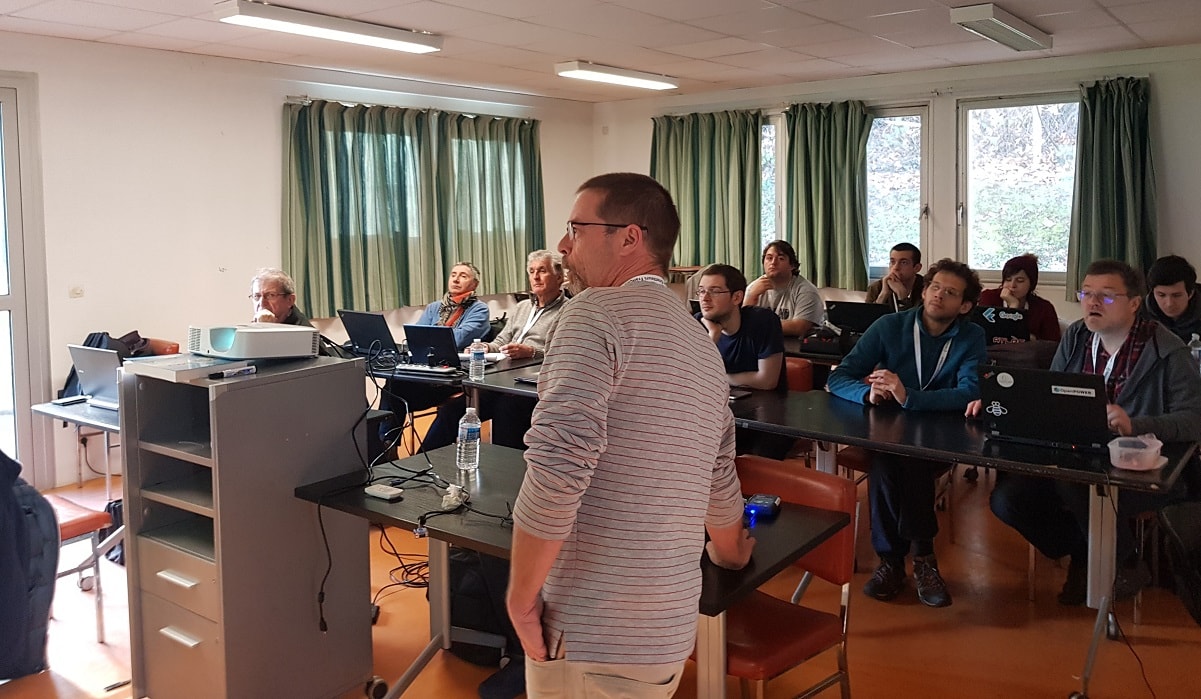
More than 30 “SDR Geeks” attended the first SDR Winter School, organized jointly by RCN-EG, the R​.​E​.​F. and group of trainers (Sylvain F4GKR, Eric F5HSV, Evariste F5OEO and Mehdi F4IHX) in the south suburbs of Paris from the 17thto the 21stof February.

The event was open to everybody and was attended by a very wide audience: whilst there was just a majority of licensed amateurs, there were 14 non-amateur attendees, some having no idea of what amateur radio is. Those attending ranged from 19 to 74 years old, coming from 4 countries (France, Belgium, Algeria and Senegal), many by train and plane. 

Participants at the SDR Winter School

The teaching program was structured in two parallel tracks:

  • The initiation track, dedicated to overview existing applications and tools (GnuRadio, LuaRadio, AdalmPluto, DATV etc.);
  • The expert track, focused on theory, DSP tips and tricks, covering topics like sampling, decimation and interpolation, demodulation, FFT processing, software architecture etc. For each topic a set of Jupyter Notebook Python examples were provided to implement the theory.

We also welcomed three guests for special sessions:

  • Satellite communication, presented by AMSAT‑F;
  • SDR Hardware, presented by Yannick F4HDA;
  • Radio astronomy by Jean-Jacques F1EHN.

While the entire program was free, it was possible at a limited cost to use the facilities available at the venue (restaurant and bedrooms). IARU R1 and REF also sponsored a few of the youngest visitors who could not afford the full cost.

Print This Post

7X7X

Back in March 2014, The Algerian and Tunisian Member Societies have signed a cooperation agreement to reinforce relations through joint activities. Part of the agreement was to exchange visits and conduct DXPeditions.

excellent take-off

The idea of arranging a DXPedition in Algeria in 2019 was appreciated by both societies. Preparations started end of October 2019. The idea was to activate Algeria on low bands and benefit from the low solar cycle conditions. 

We wanted to make this DXPedition a good opportunity to boost youngsters interest in the hobby so we involved 4 youngsters in the event; Sarra 7X2QV (23 years, YL), Lotfi 7X2QC (24 years), Marwa 3V8CB (24 years, YL) and Ahmed 3V1B/KG5OUE (22 years). Three of these youngsters were in YOTA events held by IARU. 
The involvement of the youngsters was from the preparation work to the stations dismantle. In addition to being on the air, everyone had something to work on. 

The rest of the team included Afif 7X2RO (co-Leader), Ash 3V8SF/KF5EYY (co-Leader), Mohamed 7X3TL (27 years), Redha 7X5QB and Abdelghani, 7X2TT/M0NPT. The responsibility of these OMs was to drive the event and prioritize knowledge transfer over being on-the-air.

The Tunisian team flew from Tunis to Algiers. They arrived late on December 28th to Bejaia city joining the Algerian Team. We immediately started putting up antennas. 

Abdelghani 7X2TT kicked off operation through Eshail and continuously making demonstrations and providing information to the youngsters on satellite operation and set up. 
The rest of the team built a 26m high inv‑L for 160, a full Quarterwave vertical for 80, a 2 element Fritzel yagi for high bands, a 7 elements yagi for VHF, a K9AY receiving loop, a GP for 30m then adding a coil for it to operated on 40 as well. 
We did our best to operate 2 stations at a time. We had a quite few technical issues but we overcome them.

Part of the DXPedition objectives was to socialize and build a strong team capable of making bigger plans in the future. Although we ended up with 5800 QSOs in 4 days, the operating schedule was intentionally not made tight. 

On December 31st, we had a nice BBQ dinner together insitue that we really enjoyed!

The log inluded QSOs split as follows: 38% CW, 55% SSB, 7% FT8. It was nice to see youngsters favoring SSB operation over FT8.
We had 1121 QSOs on 160m and 798 QSOs on 80m. 356 US stations and 30 JAs worked on 160. 

The DXPedition team highly value the support we got from NCDXF, LSDXA and MDXC along with some other individual hams. This support is a solid investment into the future of ham radio hobby. We urge all DXPeditioners to involve youngesters in their future trips and do their best to make it easy and least costly for them. 

Written by Ashraf Chaabane, 3V8SF/KF5EYY

Print This Post