Menu
Tunisia issues personal licences to operate

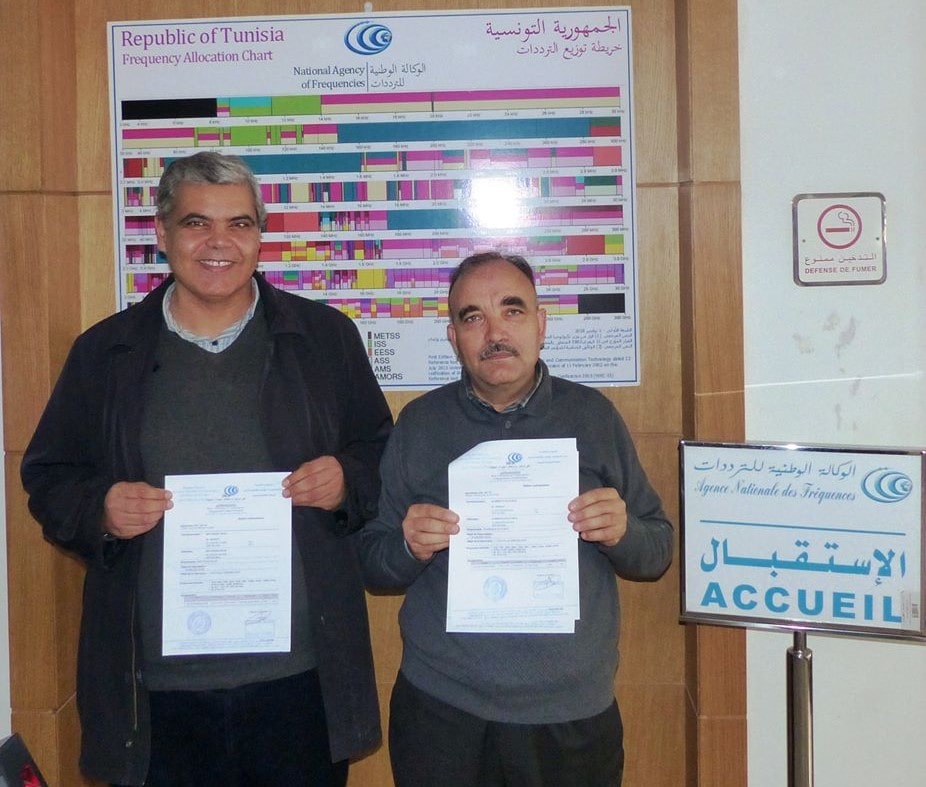
The first Authorizations to Operate have been issued to three Tunisian amateurs. These are the first issued since 1956. 3V8HB, 3V8MN and 3V1MB will soon be on the air from their homes rather than being restricted to operating from a club station.

Issuing individual authorisations to operate is a new process in Tunisia and involves a number of stages, including equipment conformity checks.

This is great news for Tunisians that the process now exists so that radio amateurs can practice their hobby from homes in full compliance with the Tunisian Laws. The IARU Member Society ARAT extends its thanks to the National Agency of Frequencies, the Ministry of Telecommunications and all involved parties for making this happen.

Print This Post

DK2OM receives IARU Diamond Award

After many years’ involvement in monitoring intruders on the amateur bands, Wolf Hadel, DK2OM, has decided to retire at the end of 2019. Wolf has worked for the DARC monitoring system in Germany for more than 30 years and since 2005 has also coordinated the IARU Monitoring System of Region 1 (IARUMS).

Wolf has made a name for himself over the years as a committed radio amateur and competent band guard, and he is known for his excellent contacts with the official spectrum monitoring units. At Ham Radio 2016, it was my pleasure to award him the IARU Region 1 medal for his fight against illegal intruders on our bands and to recognize his ongoing exceptional leadership of the successful IARU monitoring system.

Wolf has worked closely with monitoring activities in the other IARU Regions and has built an excellent reputation amongst his colleagues around the world.

Wolf has also worked as a competent specialist author in recent years, together with Peter, HB9CET, and has mainly reported on digital intruders and Over-the-Horizon radars (OTHR) and has published monthly the much-respected IARU MS Newsletter. 

In recognition of his contribution to spectrum monitoring over the years, not just in Region 1 but across the whole of IARU, on his retirement Wolf has been awarded the IARU President’s Diamond Award for his outstanding contribution to amateur radio spectrum defence through leadership of the IARU Monitoring Service. This is a well-deserved recognition of a very significant contribution to the amateur radio service. I congratulate Wolf on this award and sincerely thank him for his work over the years. We all wish Wolf a happy retirement. 

Until the General Conference of IARU Region 1 in October 2020 in Novi Sad, IARUMS Region 1 Vice-Coordinator Peter Jost, HB9CET, will perform these tasks as Coordinator ad Interim, supported by Gaspar Miró, EA6AMM, URE coordinator of the Spanish Intruder Watch. I thank Peter and Gaspar for their willingness to maintain the IARU Monitoring System of Region 1 until the Conference next year.

Don Beattie, G3BJ, President IARU Region 1

Print This Post

IARU speaks at ATU Workshop

IARU was present at the recent ATU African Telecommunications Union / ICT Day 2019 Commemorative Workshop — “Using Technology to Save Lives: Emergency Communications for Disaster Risk Reductions and Management”. The Workshop was held in Maputo, Mozambique and IARU was represented by Brian Jacobs, ZS6YZ and Leon Lessing, ZS6LMG. Brian presented an overview of the amateur capability for emergency communication and some of the pre-conditions for it to be effectively deployed. He also gave a second presentation on the IARU STARS program, which seeks to support and encourage the growth of amateur radio in countries where it is not well established. 

Both presentations were well received, and gave rise to extended discussions about the public service role of amater radio and its role in developing the national skill infrastructure. 

Print This Post

WRC-19 more details on the 50 MHz changes

IARU has released a more detailed report on the outcome of Agenda Item 1.1 (50 MHz) at the recent WRC in Egypt. Proposals from administrations and Regional Telecommunications Organisations (RTO) around the world ranged from no allocation at all to the provision of a 4 MHz primary allocation. The IARU position was to seek a 4 MHz primary allocation in Region 1 in common with that in other ITU regions.

Pre WRC situation in Region 1

Prior to WRC 2019, a number of countries in Africa enjoyed a primary allocation in all or part of the band. A number of other countries in Region 1 had secondary allocations on a national non-interference basis.

Post WRC situation in Region 1

A secondary amateur allocation in Region 1 in the band 50 – 52 MHz is included in the Table of Frequency Allocations in the ITU Radio Regulations.
In Botswana, Eswatini, Lesotho, Malawi, Namibia, South Africa, Zambia and Zimbabwe, 50 — 54 MHz on a primary basis with protection from other services. 
In Senegal, 50 — 51 MHz on a primary basis with protection from other services. 
In Angola, Saudi Arabia, Bahrain, Burkina Faso, Burundi, the United Arab Emirates, Gambia, Jordan, Kenya, Kuwait, Mauritius, Mozambique, Oman, Uganda, Qatar, South Sudan and Tanzania, the frequency band 50 — 54 MHz is allocated to the amateur service on a primary basis. 
In Djibouti and Lebanon, the frequency band 50 — 52 MHz is allocated to the amateur service on a primary basis.
In Guinea-Bissau, the frequency band 50.0 — 50.5 MHz is allocated to the amateur service on a primary basis. 
In Austria, Cyprus, the Vatican, Croatia, Denmark, Spain, Finland, Hungary, Latvia, the Netherlands, the Czech Republic, the United Kingdom, Slovakia and Slovenia, the frequency band 50.0 — 50.5 MHz is allocated to the amateur service on a primary basis.
In the Russian Federation the frequency band 50.080 50.280 MHz is allocated to the amateur service on a secondary basis. 

Main Outcome of WRC-19

Final approval of the outcome was delayed until Thursday 21 November as a consequence of sensitive political issues. However following approval:

  • Pre WRC-19 countries retain their current status in the 50 — 54 MHz frequency band.
  • The Democratic Republic of Congo removed itself from the list of pre WRC-19 countries.
  • The amateur service has a secondary table allocation in most of Region 1 in the 50 — 52 MHz band.
  • 44 Region 1 countries have a primary allocation in all or part of the 50 — 54 MHz band.
  • 14 CEPT countries have a 500 kHz primary allocation in the 50.0 — 50.5 MHz band.
  • The Russian Federation has a 200 kHz secondary allocation in the 50.08 — 50.28 MHz band.
  • The Final Acts of WRC-19 enters into force on 1 January 2021, however administrations may make provisions to provide 50 MHz spectrum at an earlier or later date.
  • Amateur service shall not cause harmful interference to stations of other primary or secondary services, with the exception of the pre-WRC-19 countries.
  • Individual amateurs should not use (unless already licensed to do so) the newly allocated spectrum until their national licensing authority has given the go ahead for its use.
  • Prior to WRC-19 a number of countries in CEPT had authorised national usage in the 50 — 52 MHz band on a non-interference basis to stations of other primary and secondary services. In practice little is likely to change here, although the amateur service with a secondary table allocation in Article 5 of the ITU Radio Regulations (and hopefully the European Common Allocation Table) will now have a higher status internationally in the 50 — 52 MHz frequency band after the entry into force of the Final Acts. Furthermore, amateurs will benefit from the additional stations likely to be authorised in other countries as a consequence of the WRC-19 decisions.

Next Steps

To address the 50 MHz issue at CEPT’s Working Group Frequency Management meeting when the European Common Allocation table is revised.

Country by Country situation

The table at http://​www.iaru-r1.org/wiki​/VHF​#50 – 54_MHz_.286_m.29is IARU’s understanding of the before and after WRC19 position on 50 MHz allocations in Region 1. IARU cannot be held responsible for any inaccuracies and the definitive position is the responsibility of individual national administrations.

Print This Post

WRC-19 Approves Region 1 50 MHz Amateur Allocation

Sharm El-Sheikh, Egypt, 21 November 2019

The World Radiocommunication Conference WRC-19 has approved an allocation in the 50 MHz band for amateurs in Region 1. The decision will now be incorporated in the Final Acts of the conference.

The decision comes after more than three weeks of strenuous negotiations to reconcile widely disparate views of Region 1 administrations. The result is a dramatic improvement in the international Radio Regulations for amateurs in Region 1. Before WRC-19 there were only 11 countries in Africa with a primary allocation in the band. When the Final Acts take effect, on a date that has not yet been determined, there will be 44 countries in Region 1 with a primary allocation of at least 500 kHz including 26 countries with a primary allocation of the entire band 50 – 54 MHz. The entire region will have an amateur secondary allocation of 50 – 52 MHz except in the Russian Federation, whose administration opted for only 50.080−50.280 MHz on a secondary basis. There are provisions to protect the other existing services that use the band in Region 1 and neighboring countries in Region 3. The existing primary allocation of 50 – 54 MHz in Regions 2 and 3 is unaffected. The exact manner in which the allocations will be implemented in Region 1 countries will be determined by each administration and may be either more generous or less, depending on national considerations.

The WRC-19 decision on its agenda item 1.1 is the culmination of years of effort by the IARU and its member-societies, mainly in Region 1 but with support from the other two regions. The ITU Radiocommunication Sector working group in which preparations were conducted was chaired by Dale Hughes, VK1DSH, of Australia who also was chosen to chair the sub working group dealing with the item at the WRC. The sub working group, designated 4C1, held 10 meetings before reaching an agreement that could be forwarded to Working Group 4C where additional discussions and adjustments took place. Committee 4 received the output of 4C on Tuesday, 12 November and performed additional fine-tuning before recommending the results for adoption by the conference Plenary. Consideration by the Plenary was delayed while a narrow issue in one footnote was resolved.

IARU Vice President Ole Garpestad, LA2RR, who is attending the WRC as a member of the Norwegian delegation, observed: “The successful outcome on Agenda Item 1.1 could only have come about through a team effort by the IARU member-societies and regional organizations, and especially by the volunteers who have devoted countless hours to preparing documents and attending meetings over the past three years. Our thanks go to everyone who has contributed to this effort, including the radio amateurs who support the IARU through membership in the IARU member-society in their country.” LA2RR coordinated overall IARU preparations for WRC-19. Dave Court, EI3IO, led the IARU effort on Agenda Item 1.1 which engaged all six regional telecommunications organizations: ASMG for the Arab States, ATU for Africa, CEPT for Europe, RCC for Russia and several countries of the former Soviet Union, CITEL for Region 2, and APT for Region 3. Region 1 Secretary Hans Blondeel Timmerman, PB2T, was coordinator for the item on behalf of CEPT on whose proposal the ultimate compromise was largely based.

Print This Post