Menu
IARU AC meets in Lima

IARU Administrative Council Steps Up Efforts to Combat Radio Spectrum Pollution

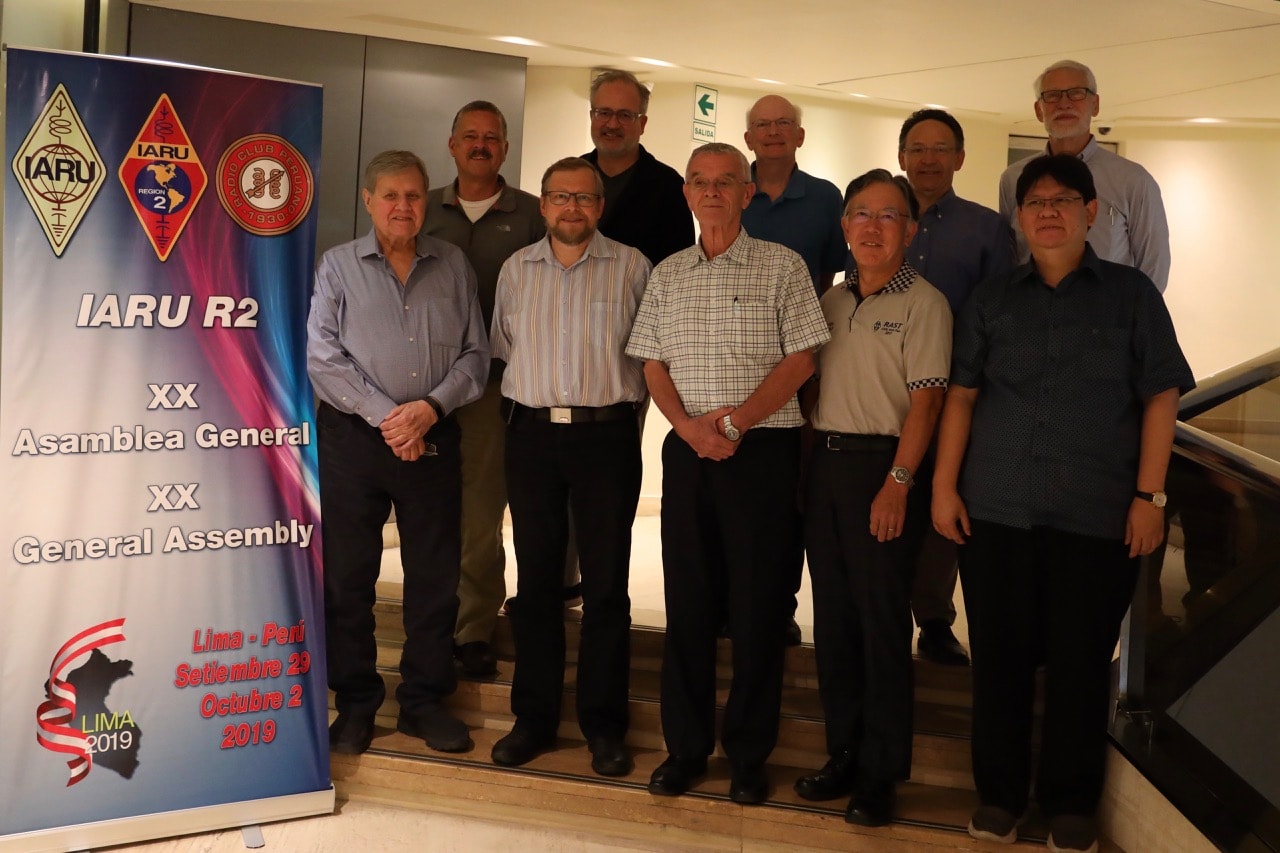
The Administrative Council (AC) of the International Amateur Radio Union (IARU) held its annual in-person meeting on 28 and 29 September 2019 in Lima, Peru, just before the triennial General Assembly of IARU Region 2. The AC is responsible for the policy and management of the IARU and consists of the three IARU international officers and two representatives from each of the three IARU regional organizations.

Attending the meeting were IARU President Tim Ellam, VE6SH/G4HUA; Vice President Ole Garpestad, LA2RR; Secretary David Sumner, K1ZZ; regional representatives Don Beattie, G3BJ, Hans Blondeel Timmerman, PB2T, Reinaldo Leandro, YV5AM, Ramón Santoyo, XE1KK, Wisnu Widjaja, YB0AZ, and Ken Yamamoto, JA1CJP. Region 2 executive committee member George Gorsline, VE3YV, was present as an observer.

The AC conducted its final review of IARU preparations for the 2019 World Radiocommunication Conference (WRC-19) of the International Telecommunication Union (ITU). WRC-19 will be held in Sharm El-Sheikh, Egypt, for four weeks beginning on 28 October. The conference has a lengthy agenda, with items of direct interest to the amateur service including consideration of improvements to the amateur allocation in Region 1 at 50 MHz, protection of existing allocations to the amateur service, and development of the agenda for the next WRC in 2023. For the past four years IARU volunteers and its member-societies have been working to influence the proposals from national telecommunications administrations and regional telecommunications organizations (RTOs) that will be considered in Sharm El-Sheikh. IARU efforts have reduced the number of potentially damaging proposals that otherwise might have been offered for consideration, but several challenges remain. A small team of IARU observers will attend WRC-19 and will work with amateurs and friends on national delegations to reach the best possible outcomes.

Looking beyond WRC-19 the AC recognized the need for an increased commitment to influencing the work of standards organizations, particularly the International Special Committee on Radio Interference (CISPR) and its participating national committees. The rising level of radio spectrum pollution caused by unnecessary and unwanted emissions from electronic devices such as wireless power transfer for the recharging of electric vehicles is a serious threat to radiocommunication services including the amateur service. While the work of the IARU is done by volunteers, attending meetings is expensive and requires the financial support of individual radio amateurs through membership of their national IARU member-societies. Additional qualified volunteers are needed in order to meet present and future challenges.

An extensive discussion was held to identify the principal challenges facing amateur radio and how the IARU and its member-societies can better address them.

Upgrading of the current websites of the IARU and its three regional organizations is underway and should be completed in the coming months. The AC adopted a Brand Guide to ensure a common identity across the IARU organization.

The theme for next year’s World Amateur Radio Day, 18 April, was confirmed as “Celebrating Amateur Radio’s Contribution to Society.”

The next in-person meeting of the AC is scheduled to be held immediately prior to the IARU Region 1 Conference in Novi Sad, Serbia, in October 2020. Virtual AC meetings are also planned beginning in December 2019 and January 2020.

Print This Post

CEPT Project Team meets in Switzerland

IARU was represented at the recent meeting in Switzerland of CEPT PTD. This was the last of the CEPT project team meetings preparing European Common Proposals (ECP) for a number of agenda items of the ITU World Radiocommunication Conference (WRC), which takes place during November 2019. From an amateur radio standpoint, WRC-19 agenda item 1.1, which addresses the possibility of an allocation in Region 1 of the 50 ‑54 MHz frequency band, was the key issue to be resolved.

PTD agreed the text of an ECP for WRC-19 which, if adopted at the WRC, would see an entry in the international table of allocations for Region 1 and would allocate the 50 – 52 MHz frequency band to the amateur service on a secondary basis. In addition a footnote to the international table was agreed which would permit individual CEPT countries to introduce a national primary allocation in the 50.0 – 50.5 MHz sub-band.

The final meeting of CEPT’s Conference Preparatory Group (CPG) will take place in the week beginning 26 August and will finalise CEPT’s input to WRC-19. IARU will attend the CPG to represent the views of the amateur service.

Print This Post

IARU asks Member Societies to support its WRC-19 work
WRC-2019 logo
WRC-2019

The World Radiocommunication Conferece, WRC 19, is just five months away and Regional Telecommunications organisations and individual countries will shortly be finalising their positions for the Conference.

IARU Region 1 has now mailed every member society providing guidance on actions which they should take with their national spectrum regulator to advocate support for the amateur service position on relevant WRC Agenda Items.

If any member society has not received this mailing, please contact president@​iaru-​r1.​org

Print This Post

WRC-23 Agenda Items — update from CEPT
CEPT logo

IARU was represented at the meeting of CEPT Project Team A (responsible for some aspects of the CEPT position for WRC-19), which has just finished in Prague. Of particular interest were discussions on two proposed Agenda items for WRC-23, concerning the sharing of the 1240 – 1300 MHz band with the Galileo navigation system and the proposal from France to study a range of frequencies, including the 144 MHz amateur band, for future aeronautical applications.

The output from PTA does not carry forward the Galileo proposal, but it is likely that further discussions will take place prior to the Conference Preparatory Group meeting in August. Meantime work on this issue will also continue in other specialist CEPT forums. IARU will continue to support this approach and it believes this will be the most efficient method for developing the sharing guidance required to protect Galileo operations in a timely manner.

Regarding new aeronautical frequencies (including 144 – 146 MHz), the proposal was not strongly opposed by administrations and has been carried forward to the higher level CEPT Conference Preparatory Group (CPG) meeting in August for final adoption.

IARU views with grave concern any proposal to include the 144 MHz band in the proposed aeronautical agenda item and will be making every effort to fully protect amateur radio interests and seek the support of regulators in this regard.

The band 144 – 146 MHz is allocated globally to the amateur and amateur satellite services on a primary basis. It is the only globally harmonised VHF band for the amateur and amateur satellite service. As such it is an important and widely used part of the amateur spectrum with a vast installed base of both terrestrial/maritime amateur users and systems and operational satellite stations including the International Space Station (ISS).

This heavily used band supports a large number of repeater stations, segments for weak-signal long distance terrestrial and EME (Earth-Moon-Earth) communications, satellite and ISS usage, data services, as well as conventional terrestrial and tropospheric communications. The Primary status of the band has also enabled a number of amateur aeronautical uses including on manned flights and high-altitude balloons. Supporting all of this is a wide variety of commercial and experimental equipment, ranging from ultra-low noise preamplifiers for sensitive receivers, software defined radios and transmitting systems that can deliver high EIRP levels when needed to overcome high loss propagation paths.

Given the propagation to/from an aircraft at altitude, it is entirely possible that harmful interference to sensitive amateur and amateur satellite receivers will be caused over a 1,000 km radius of a single aircraft.

IARU will shortly be providing a brief to Member Societies and other interested parties, asking them to discuss the French proposal with their administrations well in advance of the August CEPT-CPG meeting.

It is possible that France will seek to introduce into other Regional Telecommunications Organisations (RTO) the same proposal to study the 144 – 146 MHz band for aeronautical use. IARU will provide a brief shortly to enable representations to be made to administrations in countries under those RTOs for protection of this amateur spectrum allocation.

Print This Post