Menu
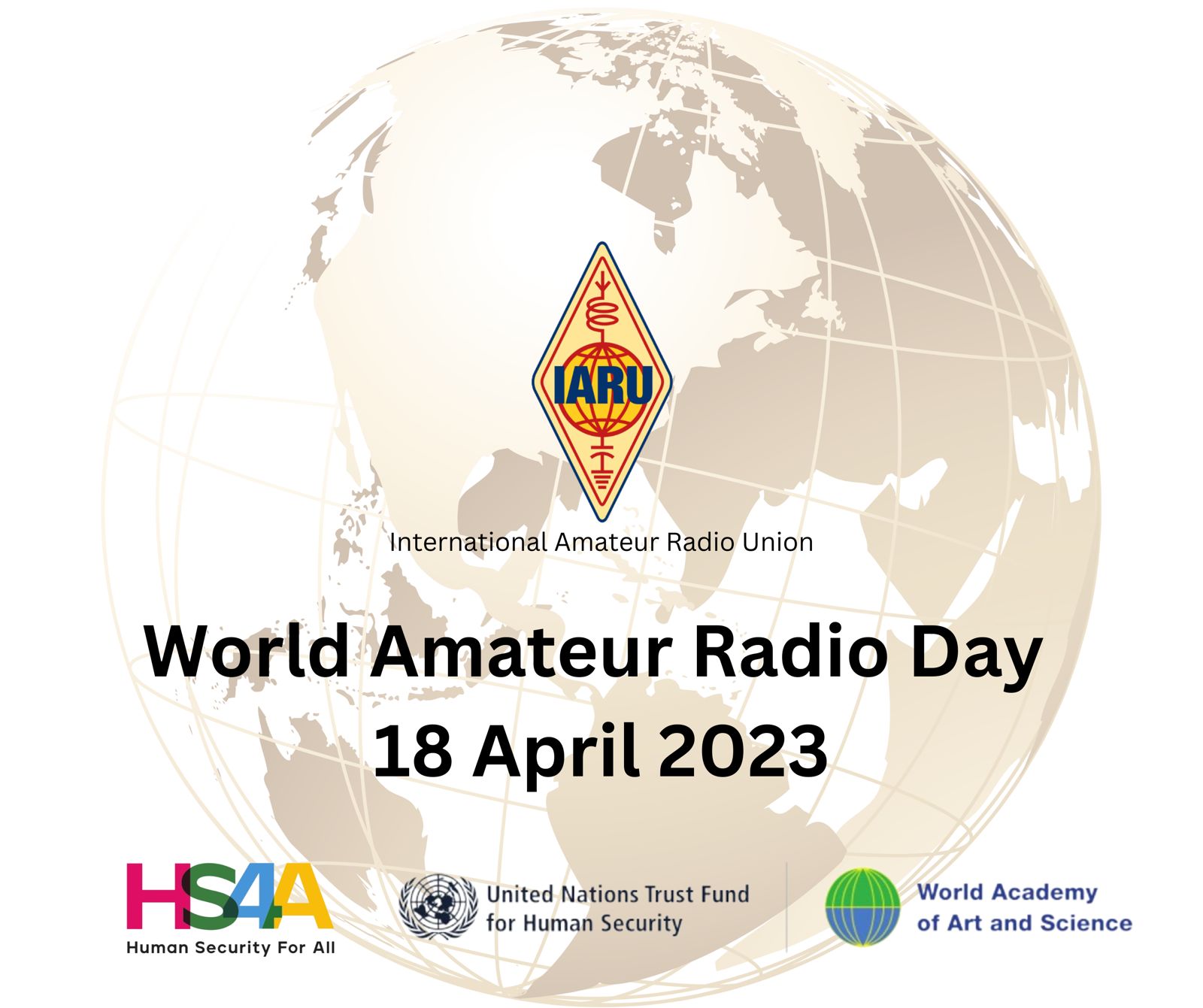
Special Theme for World Amateur Radio Day 2023 Announced

The International Amateur Radio Union announces that Human Security for All, HS4A, will be the theme of World Amateur Radio Day on 18 April 2023. For the first time, the United Nations Trust Fund for Human Security and the World Academy of Art and Science are partnering with IARU in a campaign to highlight the role that amateur radio plays in addressing the world’s most pressing needs.

Human Security measures security at the individual level. First introduced by the U.N. in 1994, the concept identifies seven interrelated dimensions of security that are essential to an individual’s wellbeing: economic, food, health, environmental, personal, community and political.

The partners believe Amateur Radio is uniquely positioned to address people-centered, context-specific security challenges by promoting technical knowledge, practical skills, innovative technology, and the deployment of backup systems at the community level that can be called upon in times of emergency. The pandemic, climate change, natural disasters, and armed conflicts on several continents undermine our security and respect no boundaries. Amateur Radio has repeatedly demonstrated its ability to address human security needs. It is a truly global communications medium comprising some three million radio enthusiasts connecting communities and the peoples of the world. 

IARU, a federation of the national amateur radio societies of over 150 countries worldwide, is the global advocate for amateur radio through its Sector Membership in the International Telecommunication Union, an agency of the U.N., and other activities. In celebration of World Amateur Radio Day, IARU and its member-societies will be conducting a special two-week on-the-air event 11 – 25 April. Special event stations will be operating from around the world, making two-way radio contacts to call attention to the HS4A campaign.

Print This Post

DX-Unlimited: Arnie Coro, CO2KK — SK

ARNALDO CORO ANTICH (CO2KK) DIED TODAY AT THE AGE OF 80, report Horacio A. Nigro, CX3BZ, from Uruguay, and Carlos Alberto Santamaria Gonzalez, CO2JC, coordinator of the FRC national emergency network and emergency coordinator of IARU R2.

Here is the text:

“In the early hours of 8 January 2023, our colleague Arnaldo de Jesús Coro Antich (CO2KK) passed away in a hospital in the capital at the age of 80 due to complications from his chronic illnesses.

Coro’s interest in radio began, he recounted, when he received a gift from his father: a coil with a galena stone and headphones to listen to radio stations. At the age of 12, he joined what was then the Radio Club de Cuba, the association that brought together radio amateurs in the capital in the late 1950s.

In 1957, he started working at the CMBA television station Channel 7, owned by the Mestre brothers, where he brought a lot of knowledge and experience to his work.

As a journalist he worked for the press and radio, his greatest passions. We remember his column on science in the magazine Juventud Técnica and his contributions to the radio station Juventud Rebelde. He also acted as a consultant. In radio, he was a member of the team of Radio Habana Cuba until his death, his programme “DXers Unlimited” in English reached all corners of the world, from where he received a lot of listener mail. Many foreign colleagues knew him as “Arnie” Coro. He also produced columns on science and technology in programmes on Radio Progreso, Radio Taíno and Radio Metropolitana.

Arnaldo was passionate about popularising science and technology and was always on the lookout for the latest discoveries and inventions to share with listeners and friends.

As a teacher, he also taught at the Instituto Superior de Relaciones Internacionales “Raúl Roa Kourí” and at the International Institute of Journalism “José Martí”. However, his teaching activities were not limited to these; he constantly passed on his knowledge to everyone.

Since its foundation in 1966, he was a member of the Federation of Radio Amateurs of Cuba and an active member as well as a member of technical commissions and other positions, always looking for solutions to technical problems. He founded and produced the programme “Rueda del Multímetro” for a long period of time, in which he contributed to the understanding of the technical issues of amateur radio and gave answers to problems that many of his colleagues brought to him.

He actively contributed to rounds such as the Hurricane Net as well as the “Encuentro Capitalino” (Capital Meeting), where he offered his knowledge of solar activity and radio wave propagation, one of his favourite subjects, here he was a true connoisseur.

Another subject to which he devoted special interest, time and effort was emergency communications by radio amateurs. His radio station was always ready to help in case of emergencies and disasters in our country and region. At the time of his death, he was the Emergency Coordinator for Area C of Region 2 of the International Amateur Radio Union (IARU R2).

I will always be grateful for our exchanges by radio or phone about the extreme weather events that threatened our area.

Coro, who was born on 2 July 1942, received the National Radio Award 2017 radio prize.

We extend our condolences to his family on his passing.

Rest in peace my friend. We will miss you.

Carlos Alberto Santamaría González (CO2JC)
National Coordinator of the FRC Emergency Network.
IARU R2 Emergency Coordinator.

IARU R2 info on Horacio Nigro Geolkiewsky, CX3BZ, Uruguay.“


RIP, te echaremos de menos.
Tom DF5JL
IARU R1 HF Manager

(Translation DF5JL; photo: RHC)

Print This Post

USA/MoD: Start for new Over-the-Horizon Radar (OTHR) on Palau / OTHRs already number one reported intruder

Construction of a new shortwave radar for the US Air Force is currently beginning on the Pacific island of Palau. This was announced by the US Ministry of Defence (MoD) at the end of December 2022. OTHRs already top the list of reported intruders on our exclusive HF amateur radio bands.

The long-range radar, called Tactical Mobile Over-the-Horizon Radar (TACMOR), could play a special role in monitoring Chinese activities in the Pacific and the South China Sea. The client for the project is the Naval Facilities Engineering Systems Command Pacific, and the work is to be completed by June 2026, as “The War Zone” reports. 

According to “The War Zone”, the Palau OTHR will consist of a remote-controlled transmitting site and a separate receiving site consisting of 128 dual-monopole antenna elements. Signal processing will then take place in real time already at the receiving site. The data will then be forwarded to the American and allied forces via an external operational control centre.

OTHRs already top the list of reported intruders on our exclusive amateur radio bands. This is evidenced by the extensive surveys conducted by the IARU Monitoring System (IARUMS). As can be seen from the latest Region 1 statistics, Over-the-Horizon Radars were again the most reported in November, followed by transmissions in various MIL modes. It is these types of transmissions that have the greatest interference potential in our HF amateur radio bands.

(Photo: US-Navy-AN/TPS – 71-Relocatable-Over-the-Horizon-Radar-station; source: USN, public domain)

Print This Post

HAARP Asteroid Bounce Experiment

As announced, the signals of the “HAARP Asteroid Bounce Experiment” from Gakona/Alaska could also be received in DL and other parts of Europe at 9600 kHz today (27.12.) around 11 am UTC. This is shown by some reports which reached the DARC HF department on Tuesday morning. Those interested can listen to the 30 kHz wide sweep signal as a short recording at t1p​.de/​o​r​cll

“Today’s experiment by means of the HAARP facility in Gakona/Alaska is only the first preliminary stage of an attempt to investigate the interior of asteroids by means of shortwave signals from Earth,” says Tom Kamp, DF5JL, HF officer of the DARC and IARU Region 1. However, only the next few days will show whether echoes of asteroid 2010 XC15 were received at all. Until then, numerous data from the HAARP facility as well as reception reports from radio amateurs and hobby radio astronomers will be evaluated.

After all, the diameter of asteroid 2010 XC15 is only about 150 meters.

It is also twice as far away from the Earth as the Moon. In addition, radio astronomy in the short-wave range is still in its infancy.

Although Karl Jansky, a US physicist, and radio engineer, was already able to assign signals around 20 MHz to a radio source outside our solar system in 1930. In 1932, Jansky was able to determine the direction more

precisely: The signals came from the constellation Sagittarius in the center of the Milky Way. A detailed article on this and on shortwave radio astronomy, in general, is planned for the February issue of CQDL, the monthly members’ magazine of DARC.

An exciting topic not only for professionals: “The ‘Radio JOVE’ project of the NASA Goddard Space Flight Center, which observes so-called Jupiter bursts on 20.1 MHz, has proven to be particularly suitable for those interested in radio astronomy”, says Tom DF5JL. Due to their frequency and high signal strength, the signals are easy to receive even with modest means: “An eventful and usually worthwhile attempt to check one’s HF reception equipment as well as to get a taste of radio astronomy in general.”

Print This Post

Entry Level License Class for Germany

Press Release by Deutscher Amateur Radio Club (DARC e.V.)
+ DARC e.V. — Department of Education, Youth and Further Education (AJW)

Baunatal, Germany — 07.09.2022

Today, the Federal Ministry of Digital Affairs and Transport presented the draft bill of a new amateur radio regulation, which will bring some innovations for all radio amateurs. The chairman of the DARC e. V. and the Round Table Amateur Radio (RTA), Christian Entsfellner, DL3MBG was pleased: “The new regulation implements long-standing demands of the DARC and the Round Table Amateur Radio. In the future, remote operation will finally be allowed. Likewise, the ministry has implemented our demand for an entry-level class, which has existed since 2008.
This will significantly simplify the entry into amateur radio.” While the existing classes E and A will be raised in level by bringing in new topics from digital technology, class N will focus on operational knowledge, regulations and basic knowledge of the technology. Holders of the new Class N will be allowed to transmit on 2m and 70cm with a maximum power of 10 W EIRP. “In accordance with international specifications, the new entry-level class is intended to offer young people and older people in particular access to amateur radio” explains board member Ronny Jerke, DG2RON. The legally specified self-building right is not limited thereby, thus also a newbie can develop radios or Hotspots themselves, develop and take in enterprise.

The examination will follow a building up system, as it is known e.g. from the US-American amateur radio examination. Here, the exam for class N is taken first, which already contains all questions from the areas of operational knowledge and regulations. Then the technical examination for Class E and then Class A can be taken.

“The examination catalogs developed by the DARC for the three classes are structured in such a way that the contents and questions are not repeated, i.e. contents that have already been tested in a lower class no longer play a role in the examination for a higher class. All future radio amateurs pass the examinations of the class N, over E up to the class A. It should be possible to take all exams in one day,” says Education, Youth and Further Education (AJW) head of department Dr. Matthias Jung, DL9MJ.

Remote operation, which was previously not regulated, has been included in the new amateur radio regulations. In the future, holders of Class A licenses will be allowed to operate amateur radio stations remotely and also to allow other Class A radio amateurs to use them. Another important change concerns educational radio operation, which will be possible in the future without a separate educational call sign. Instead, by prefixing the prefix “DN/”, any Class E or Class A callsign becomes a training callsign.

The RTA now has 4 weeks to comment on the draft regulation. The DARC board and units have already begun a detailed review of the ordinance text and will report back in a timely manner.

The press release of the Federal Ministry of Digital Affairs and Transport can be read at bmdv​.bund​.de/​S​h​a​r​e​d​D​o​c​s​/​D​E​/​P​r​e​s​s​e​m​i​t​t​e​i​l​u​n​g​e​n​/​2​0​2​2​/​0​6​5​-​k​l​u​c​k​e​r​t​-​a​m​a​t​e​u​r​f​u​n​k​v​e​r​o​r​d​n​u​n​g​.​h​tml.

Attached to the press release is a draft of the second ordinance on the amendment of the amateur radio ordinance. This can be found as a PDF file at bmdv​.bund​.de/​S​h​a​r​e​d​D​o​c​s​/​D​E​/​G​e​s​e​t​z​e​-​2​0​/​z​w​e​i​t​e​-​v​e​r​o​r​d​n​u​n​g​-​a​e​n​d​e​r​u​n​g​-​a​m​a​t​e​u​r​f​u​n​k​v​e​r​o​r​d​n​u​n​g​.​h​tml.

(Original Press Release translated from German into English language by DK6SP)

Print This Post